Official game
Play Rolic
This game is hosted by Steam. Continue to the official page to play or download it.
Wishlist on SteamOverview
Rolic is a chill 3D puzzle platformer from Gear Nautilus, a small studio building one of the stranger cozy premises in recent memory: an entire magical forest that runs on algebra, where you solve puzzles with wizardry instead of equations. You scoot, scramble, and glide through twisting vibrant lands, run completely upside-down along massive tree branches, and crack open enchanted nuts to claim the treasures inside.
The math is the hook and the trick. Developer materials stress that you never see an actual equation. Clearing berries means combining opposite berries, which is simply a minus a in math talk. The game teaches algebraic intuition through interaction, the way Portal taught momentum, and wraps it in a cozy animal-crossing-adjacent aesthetic with a full day-night cycle.
The Steam page is live with a wishlist target and a demo in rotation, but the release date is still to be announced. This guide covers what the current build shows: the movement set, the nut-cracking loop, the forest's structure, and how the algebra layer actually works when you play it.
| Fact | Detail |
|---|---|
| Developer / Publisher | Gear Nautilus |
| Genre | Cozy 3D puzzle platformer, open world |
| Platform | Windows (Steam) |
| Release date | TBA; demo and beta signups active |
| Setting | A mystical, vibrant magical forest |
| Core mechanic | Algebraic wizardry, never visible equations |
| Movement | Scoot, scramble, glide, run upside-down along branches |
| Loop | Find enchanted nuts, crack them, earn rewards and customizations |
| Extras | Day-night cycles, quirky characters, character customization |
| Community | Discord linked from the official site |
Who it is for: fans of A Short Hike and Lil Gator Game who want a new forest to poke at, puzzle players who like rules-light discovery, and parents looking for a game that sneaks math practice into a cozy loop.
Who it is not for: players who want combat, strict puzzle logic like Stephen's Sausage Roll, or a finished game today. Rolic is still forming.
Getting Started
Beta signups run through Alpha Beta Gamer, and the demo rotates through Steam events. Wishlisting is the reliable way to catch the next playtest window.
Your first session plan
- Wander before you optimize. The forest is a meandering maze, and the best rewards hide deep within the woods. Your first hour should be a walk, not a checklist.
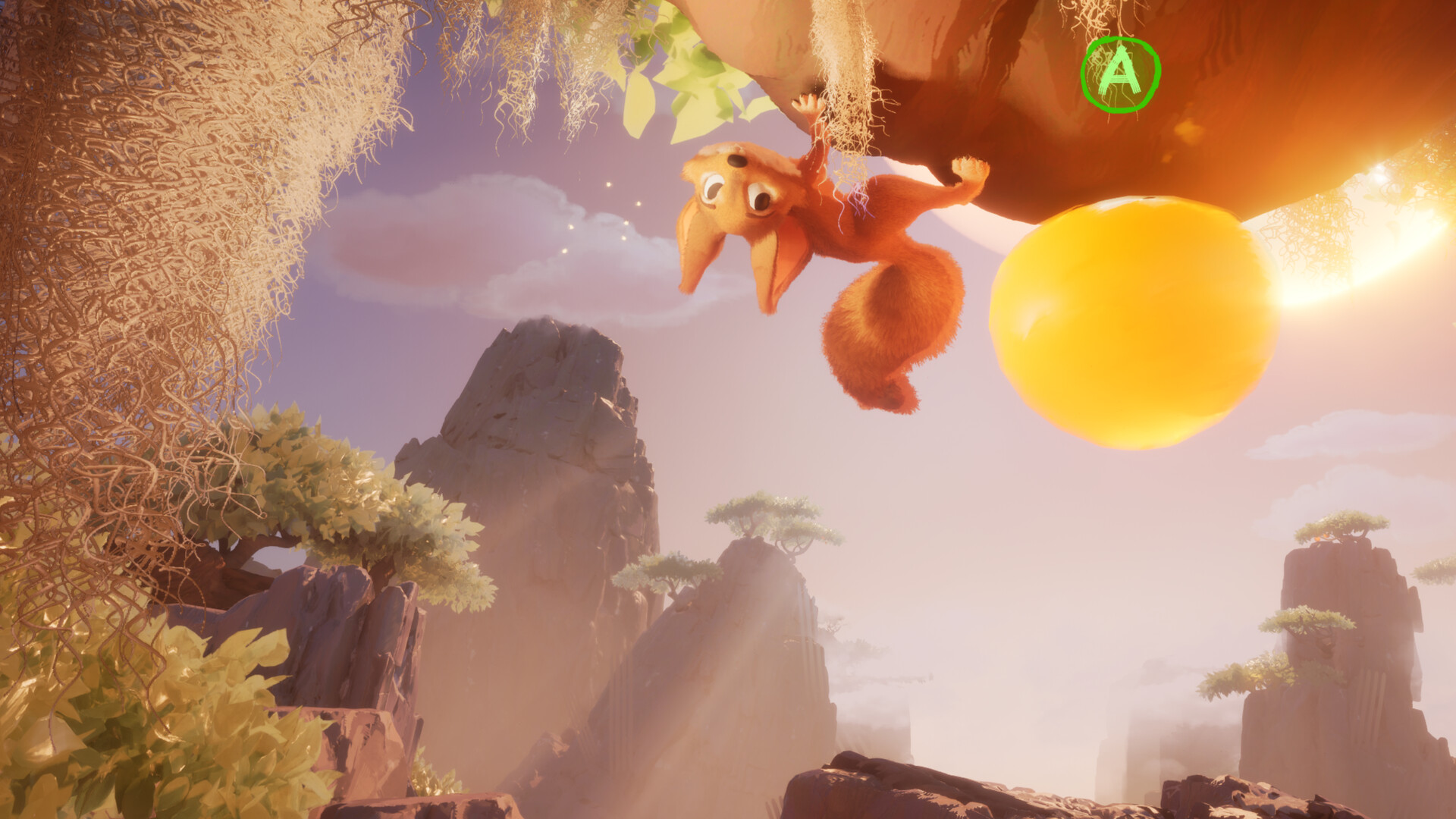
- Test the upside-down run early. Running along the underside of branches is Rolic's signature move, and several early treasures are placed to teach it. If a nut looks unreachable, check the ceiling.
- Collect nuts before you worry about cracking them. Finding hidden enchanted nuts is step one. Step two is opening them with your wizardry. Hoard raw nuts; the cracking economy rewards stockpiles.
- Talk to everything. Quirky characters hand out the forest's quests, from helping local spirits to repairing a literal broken toy for the Moon herself. Dialogue is short and the rewards are real.
- Watch the light change. The day-night cycle shifts which puzzles behave how. Some areas reward a revisit after dark.
Beginner mistakes to avoid
- Skipping berries. They look like tutorial filler. They are the algebra tutorial, and the crack-open mechanics chain back into berry logic later.
- Ignoring glide timing. The glide is floatier than it looks and covers more distance than the camera suggests. Early drops that feel mandatory are often glide-solvable.
- Fighting the camera on branches. When you run upside-down, the camera flips with you. Resisting the flip is disorienting; letting it roll makes traversal read naturally.
- Missing the forest floor. The vertical layer gets the attention, but ground-level nooks hide foraging spots and characters. Sweep low after you sweep high.
- Treating it like a task list. Rolic's pacing is deliberately chill. Players who sprint the objectives burn through content that is designed to be wandered.
Core Mechanics
Movement: the four verbs
Rolic's traversal kit is four verbs: scoot, scramble, glide, and the upside-down run. Scooting handles tight branches and quick repositioning. Scrambling climbs surfaces that look too steep. The glide covers gaps and softens every fall. The upside-down run is the star: grip any sufficiently large branch, roll to its underside, and keep running.
That single mechanic reshapes platforming space. A branch is not an obstacle; it is a road with two surfaces. The demo's level design plays with this constantly, placing treasures and puzzle entrances on the underside where a traditional platformer would never think to look.
The official Steam description calls it mind-bending movement, an entirely new sense of freedom. That is marketing inflation for most verbs; here it is roughly accurate. The freedom is in orientation, not speed.
The algebra layer: combining opposites
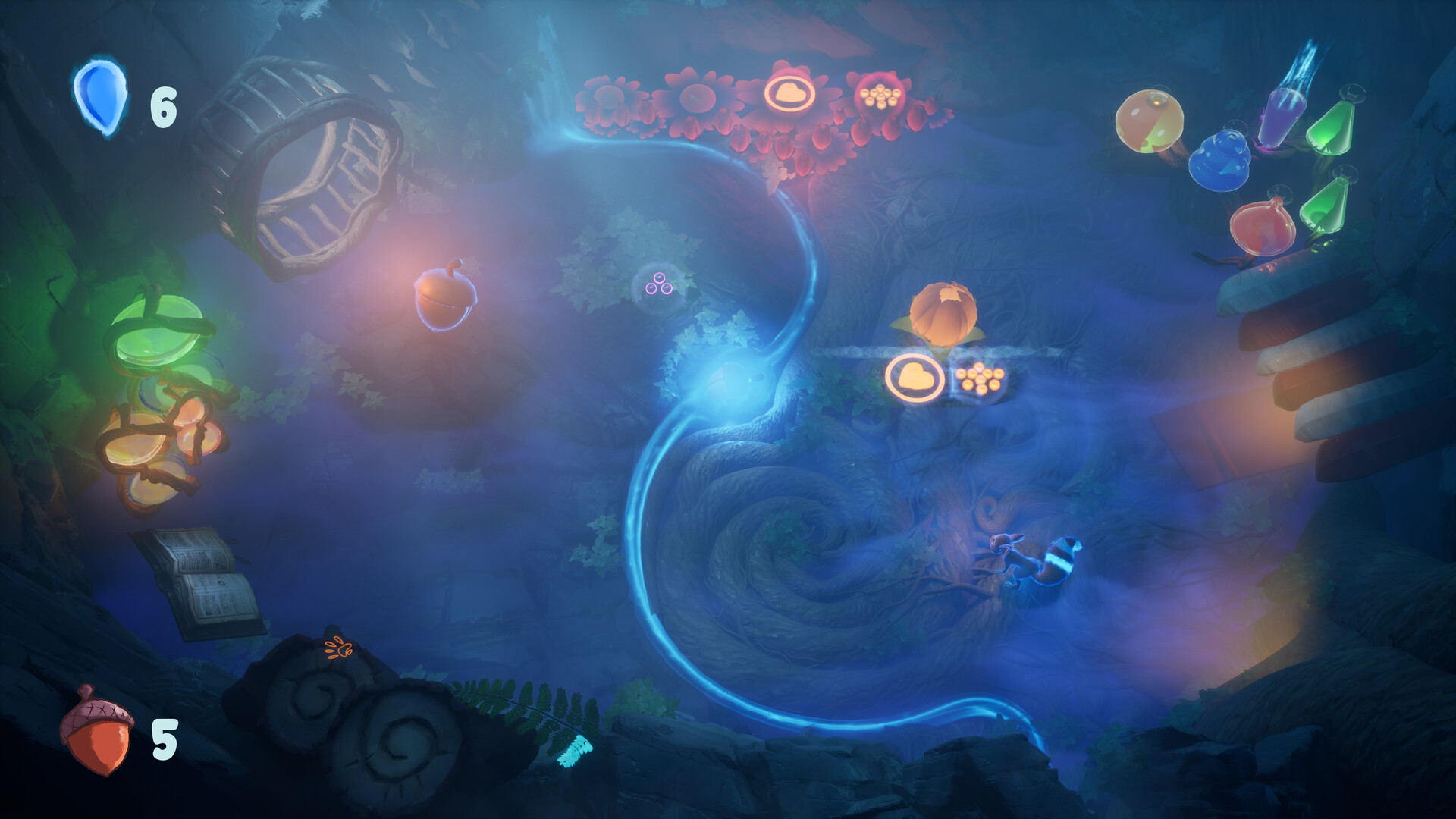
The forest's magic follows algebraic logic without ever showing math. The canonical example from the developer's own posts: clear berries by combining opposite berries, which is a minus a. That pattern generalizes. Puzzles ask you to identify pairs and properties that cancel, combine, or transform, then act on the world with them.
What makes it work is that the abstraction is physical. You are not solving for x on a worksheet. You are holding two things that clearly do not belong together, bringing them together, and watching the world respond. Instagram reels from the developer show run upside-down along giant tree branches combined with algebra-inspired wizardry solving environmental puzzles, and the never-touch-an-equation promise holds in every clip.
For parents and teachers: this is genuinely educational-adjacent. It builds the intuition that values cancel and combine before any notation appears. It is not a math curriculum. It is a forest that behaves mathematically.
The nut economy
Finding hidden enchanted nuts is only the first step. You crack them open with your wizardry to claim the treasures inside, and cracking earns powerful rewards plus character customizations. The loop is collect, crack, customize, and the customization layer is Rolic's progression spice: unlocking fun new looks personalizes your journey through the forest.
The official site runs a Puzzle Rally leaderboard with 100 puzzles and seed-based scoring, which tells you the puzzle design is meant to be replayed and compared, not just wandered once. Seeds plus leaderboards plus a cozy aesthetic is an unusual combination, and it gives competitive players a reason to master the crack-open mechanics.
Quests and the cast
The forest is populated by quirky, charming characters who need your puzzle-solving skills. The Steam description's examples give the tone: helping local forest spirits, repairing a literal broken toy for the Moon herself. Quests are short, whimsical, and woven into exploration rather than gating it. Your journey takes you through stunning day-and-night cycles to restore the land's harmony, and the restoration framing gives the collectathon a gentle purpose.
The day-night cycle
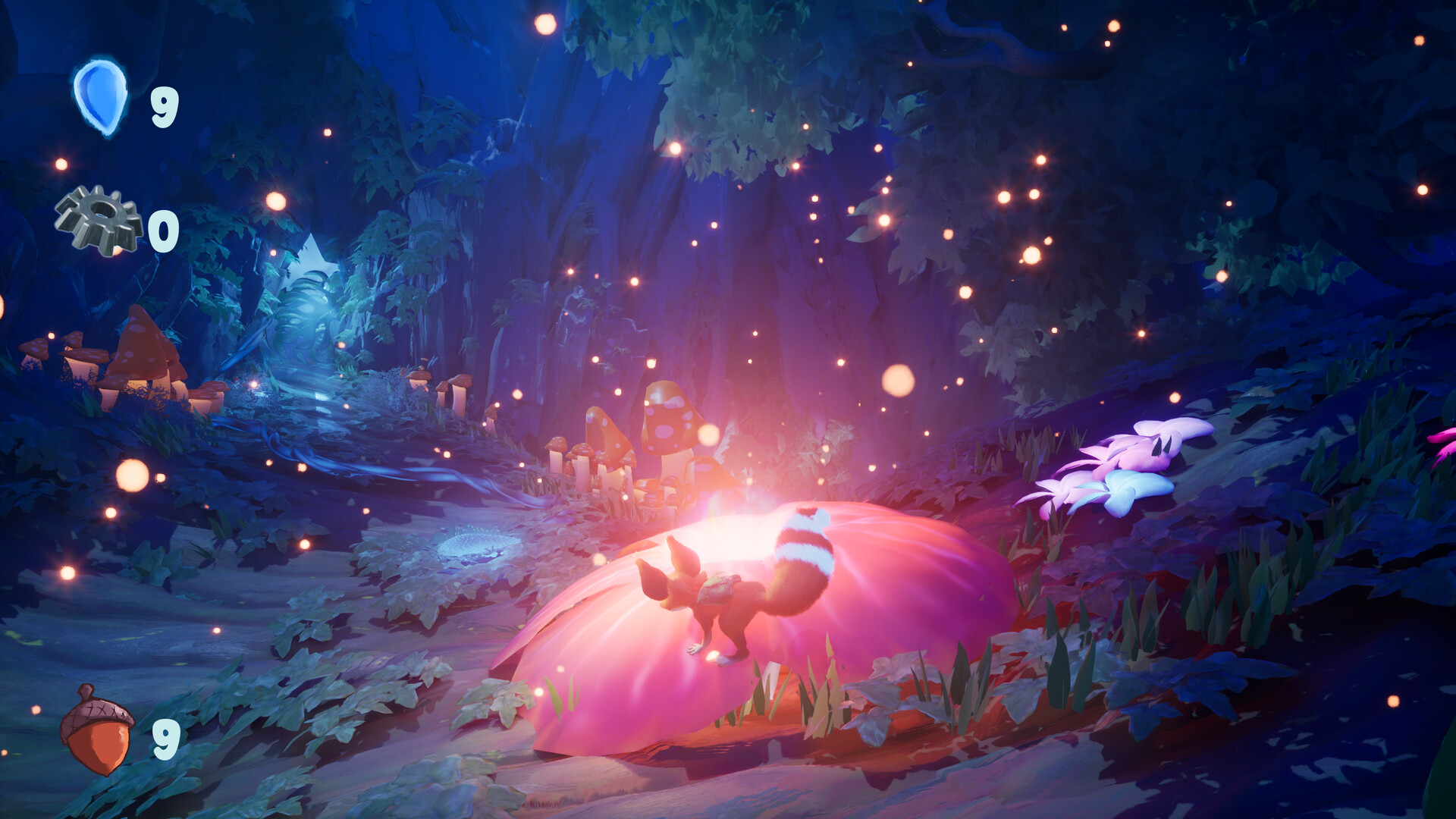
The cycle is not cosmetic. Lighting changes what you can see, some characters and events appear on their own schedule, and the forest's mood shifts enough that revisiting a morning grove at night reads as a new space. The Steam screenshots lean into it, with nighttime bioluminescent scenes sitting next to bright daytime clearings.
Advanced Tips and Strategies
Read puzzles as statements
Every algebraic puzzle is a statement waiting to be simplified. Look at what is in the space, identify the pairs and properties, and ask what cancels. Advanced players simplify the scene before they act, which turns trial-and-error into reading comprehension.
Master the underside economy
The upside-down run changes routing math. The fastest path between two nuts is often along a branch's underside rather than the ground path, because undersides connect canopies directly. Players who internalize underside routing clear collectathon sweeps in half the time.
Stockpile before cracking sprees
Cracking rewards scale with the customization unlocks, and some unlock chains want multiple cracked nuts in sequence. Collecting a stockpile, then cracking in one session, keeps you in the reward loop instead of ping-ponging between collect and spend.
Night-first route planning
Because the cycle changes puzzle behavior and visibility, advanced route planning runs problem areas at night first. Solve what night makes solvable, then sweep the same region in daylight for what the darkness hid. Reversing the order wastes trips.
Leaderboard seeds are practice rooms
The Puzzle Rally's seed system means everyone sees the same puzzle layouts. Grinding a few seeds teaches the puzzle grammar faster than open-world wandering, and the pattern recognition carries back into exploration.
Beginner's Guide: First Hours in the Forest
- Follow the light, then leave it. Tutorial zones cluster near spawn; the real forest starts where the path fades.
- Collect every berry you see, even after the tutorial. The cancel-logic returns.
- Glide before you jump-commit. Rolic is generous with airtime; most fatal-looking gaps are glide-safe.
- Accept the camera flip. The sooner you stop fighting the upside-down roll, the sooner traversal feels like flying.
- Do the Moon's quest when you find it. It is the demo's best character writing and it teaches the restoration loop that structures the full game.
World and Setting
Rolic's forest is a single connected open world built around massive trees: canopy highways, trunk shafts, root-level hollows, and the ground maze between. The art direction is saturated and toylike, closer to Lil Gator Game's plastic brightness than A Short Hike's painterly softness. Character designs lean cute-creature, with Gabrielle-adjacent smallness that makes the branches feel enormous.
The restoration narrative stays light. The forest's balance is off, the characters feel it, and your puzzle work nudges the world back toward harmony. There is no villain, no timer, and no fail state beyond falling, which the glide mostly erases.
The day-night cycle is the world's pulse. Nighttime scenes in the demo are the visual high point, with glowing flora and a quieter soundscape, and the official screenshots showcase them for good reason.
System Requirements
Steam lists minimum specs of Windows 11, an Intel Core i7-7700K, 2 GB RAM, and an RTX 2080 with DirectX 12. That graphics requirement is unusually high for the art style and likely reflects an unoptimized demo build or raytracing experiments; the final game's requirements have room to move in either direction. Check the Steam page for updates as builds ship.
Steam Deck and Platform Notes
Windows only so far, with no Steam Deck statement and no ProtonDB report for the current build. The controls are a natural controller fit, and the art style suggests Deck-friendly hardware demands, but the minimum spec listing keeps that uncertain. Watch this space once the next demo hits.
Monetization and Pricing
No price announced. Premium release, free demo and beta rotations, no microtransactions in any store material.
Community and Links
- Official site: rolicgame.com, home of the Puzzle Rally leaderboard
- Steam page: store.steampowered.com/app/4479140
- Discord: linked from the official site, the main hub for playtest access
- X / Twitter: @Rolic_game posts berry mechanics and development clips
- YouTube: the official gameplay trailer plus a small creator wave, with the Indie Games Hub trailer passing 15K views
- Beta signups: via Alpha Beta Gamer
Known Issues and Open Questions
- The release date is fully TBA. Wishlist data will likely drive the schedule.
- Minimum specifications look unreasonably high for the art style and probably reflect a temporary demo build. Expect revision.
- The demo and beta are the only playable builds; content beyond the forest's opening region is unannounced.
- Steam reviews are zero, expected for an unreleased title. Community knowledge lives in the Discord and playtest channels.
Roadmap
Gear Nautilus is in playtest mode: beta signups open, demo rotations at Steam events, and steady mechanic clips on social. The Puzzle Rally leaderboard suggests the puzzle content is further along than the release date suggests. The reasonable read is a demo-first marketing arc building toward a date announcement once the forest's full structure locks.
Comparison With Similar Games
| Game | What it shares | Where Rolic differs |
|---|---|---|
| A Short Hike | Cozy open-world exploration, glide traversal, whimsical cast | The algebraic puzzle layer and upside-down routing |
| Lil Gator Game | Toylike brightness, collectathon joy, movement-first design | A rules-based puzzle system instead of pure collection |
| Portal | Teaching real reasoning through invisible mechanics | No test-chamber framing; the whole world is the worksheet |
| Super Mario Odyssey-style capers | Movement verbs that reshape space | Chill pacing, no timer pressure, no combat |
FAQ
Is Rolic out? No. The release date is to be announced. Beta signups and demo rotations are the current access routes.
Is there a demo? The demo appears at Steam events, and beta signups run through Alpha Beta Gamer. Wishlisting catches the next window.
Do I need to know math to play? No. You never see an equation. The forest behaves algebraically and you learn the logic by doing it.
Is it educational? Educational-adjacent. It builds cancellation and combination intuition through play, but it is a cozy game first, not a curriculum.
Is it on Steam Deck? Unconfirmed. Windows is the only announced platform.
Is it multiplayer? No. It is a single-player adventure, though the Puzzle Rally leaderboard adds asynchronous competition.
Who makes it? Gear Nautilus, an independent studio self-publishing the game.
Is it like A Short Hike? Closer to that shelf than anything else: cozy, movement-forward, whimsical. Rolic adds the puzzle-rules layer and the vertical underside routing.
Quick Reference Card
| System | What to know |
|---|---|
| Movement verbs | Scoot, scramble, glide, upside-down run |
| Algebra layer | Combine opposites to cancel; no visible equations |
| Nut loop | Find enchanted nuts, crack with wizardry, earn customizations |
| Berry logic | The tutorial system that returns in later puzzles |
| Day-night cycle | Changes puzzle behavior and visibility; revisit regions |
| Puzzle Rally | 100 puzzles, seed-based, leaderboard on rolicgame.com |
| Quests | Quirky characters, Moon's broken toy, spirit favors |
| Release | TBA; beta signups open |
Screenshots