Daily Pick
One deeply researched guide worth reading today.
A practical route through the systems that matter most, written to help new players make confident decisions quickly.
Overview
Cookie Circuit - Neuroverse Estates is a free, browser-based strategy board game by indie developer Clord. You pick a VTuber-inspired avatar, race three AI rivals around a glowing circuit of cookie estates, and win by buying property, collecting rent, trading for set pieces, and timing character powers. Matches run 20 to 40 minutes, save cosmetic progress between games, and the whole thing plays in your browser at clord.itch.io/cookie-circuit. A 230 MB desktop download exists too if you prefer a local build.
The game is a property-trading board game at heart, but it layers on three systems that separate good players from lucky ones: the Overclock economy that fuels character powers, the two card decks (Glitch Queue and Swarm Mail) that create comeback swings, and the pressure system that makes late Classic matches brutally expensive. This guide walks through all of it with exact numbers: the full 40-tile board map, rent formulas, every card in both decks, all three match modes, and the AI profiles you can exploit.
| Fact | Detail |
|---|---|
| Developer | Clord |
| Engine | Phaser 3.90.0 (HTML5) |
| Platforms | Browser (itch.io), Desktop download (230 MB) |
| Price | Free |
| Players | You + up to 3 AI rivals (local, no online multiplayer) |
| Genre | Strategy / Board Game / Card Game |
| Match Length | 20-40 minutes |
| Current Version | v1.0.1 |
| Match Modes | Classic, Quick, No-Elimination Timed |
| Boards | Classic Circuit, Festival Network, Subathon Spiral, Corrupted Cloud |
| Status | In development (checked September 2026) |
Who this guide is for: anyone who wants to win their first match instead of fumbling through it. The in-game tips are friendly, but they do not tell you where to spend, when to trade, or which tiles to upgrade. This guide covers all of that.
Getting Started
Step 1: Pick Your Avatar
Five characters are playable, and each one pairs a unique power with a distinct AI personality that also shows up when that character sits at the rival table.
| Character | Archetype | Power | Overclock Cost | Playstyle |
|---|---|---|---|---|
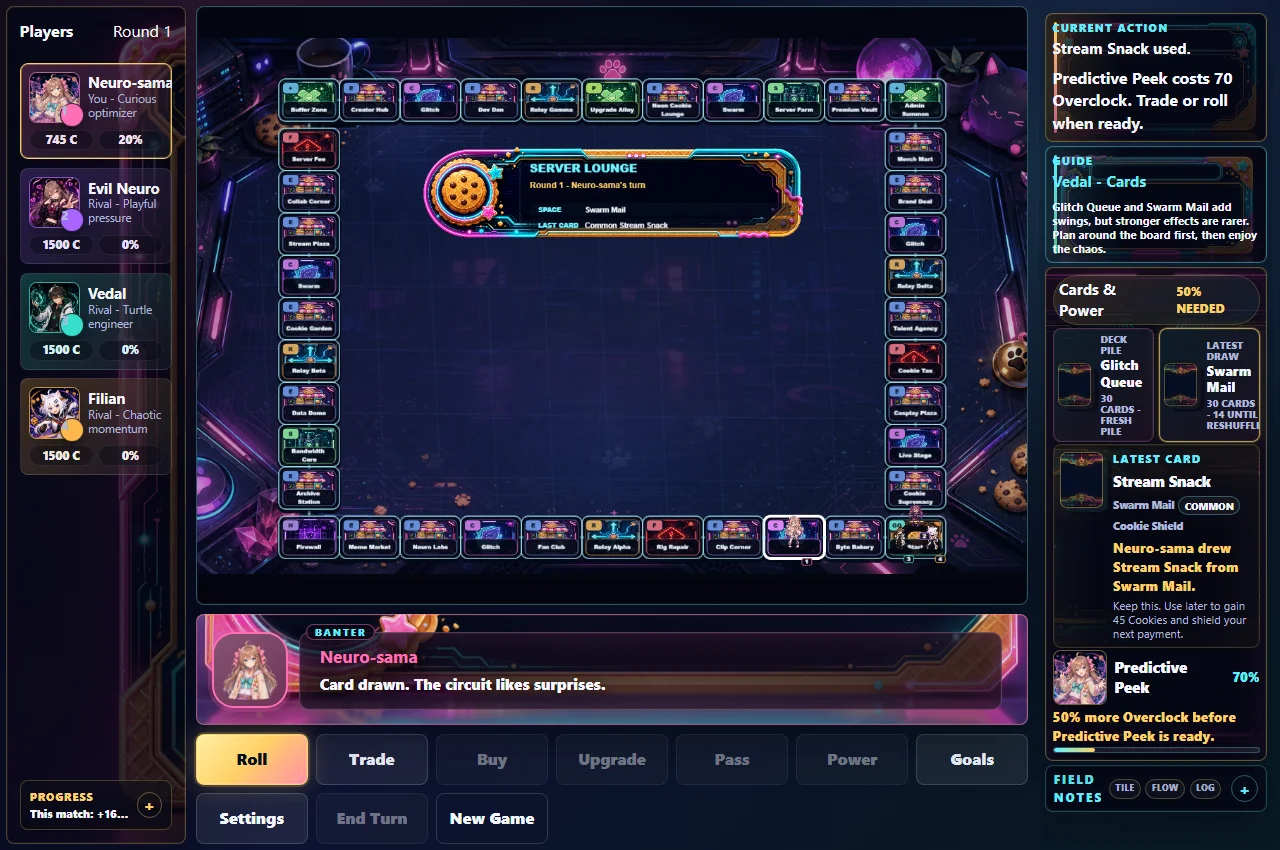
| Neuro-sama | Curious optimizer | Predictive Peek | 70 | Flexible: bend your next roll for board control |
| Evil Neuro | Playful pressure | Malicious Fork | 80 | Aggressive: pressure the richest rival |
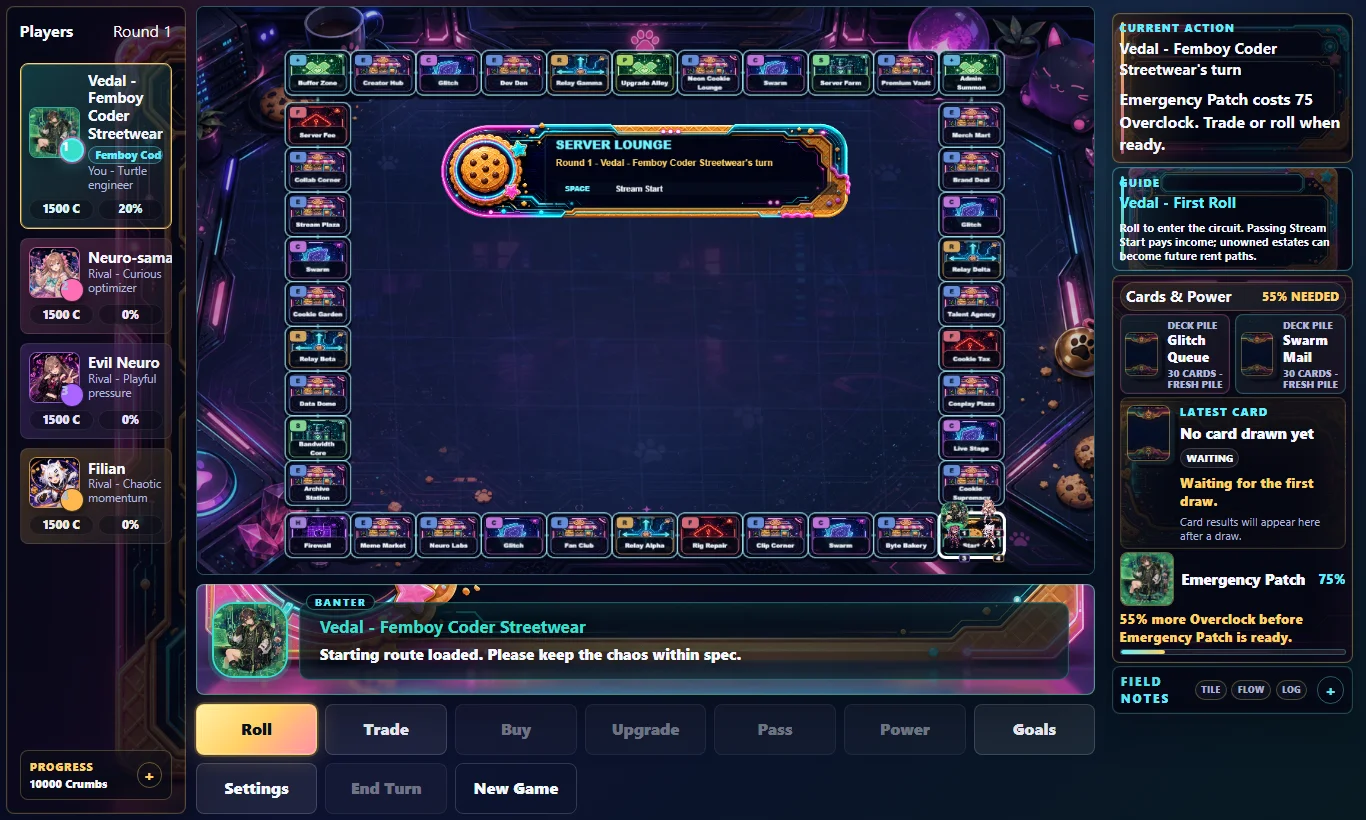
| Vedal | Turtle engineer | Emergency Patch | 75 | Defensive: shield the next painful payment |
| Filian | Chaotic momentum | Parkour Pivot | 65 | Tempo: hop to the next action tile |
| Spring Neko | Imperial cat thief | Lucky Bell | 70 | Safety: shield plus emergency cookies |
For your first matches, take Vedal. Emergency Patch is the easiest power to use well because it never requires reading the board state. Neuro-sama is the strongest for learning because Predictive Peek turns random dice into a plan. Leave Evil Neuro and Filian for later; their powers need you to know exactly who is ahead and where the action tiles sit.
Step 2: Choose Rivals and Board
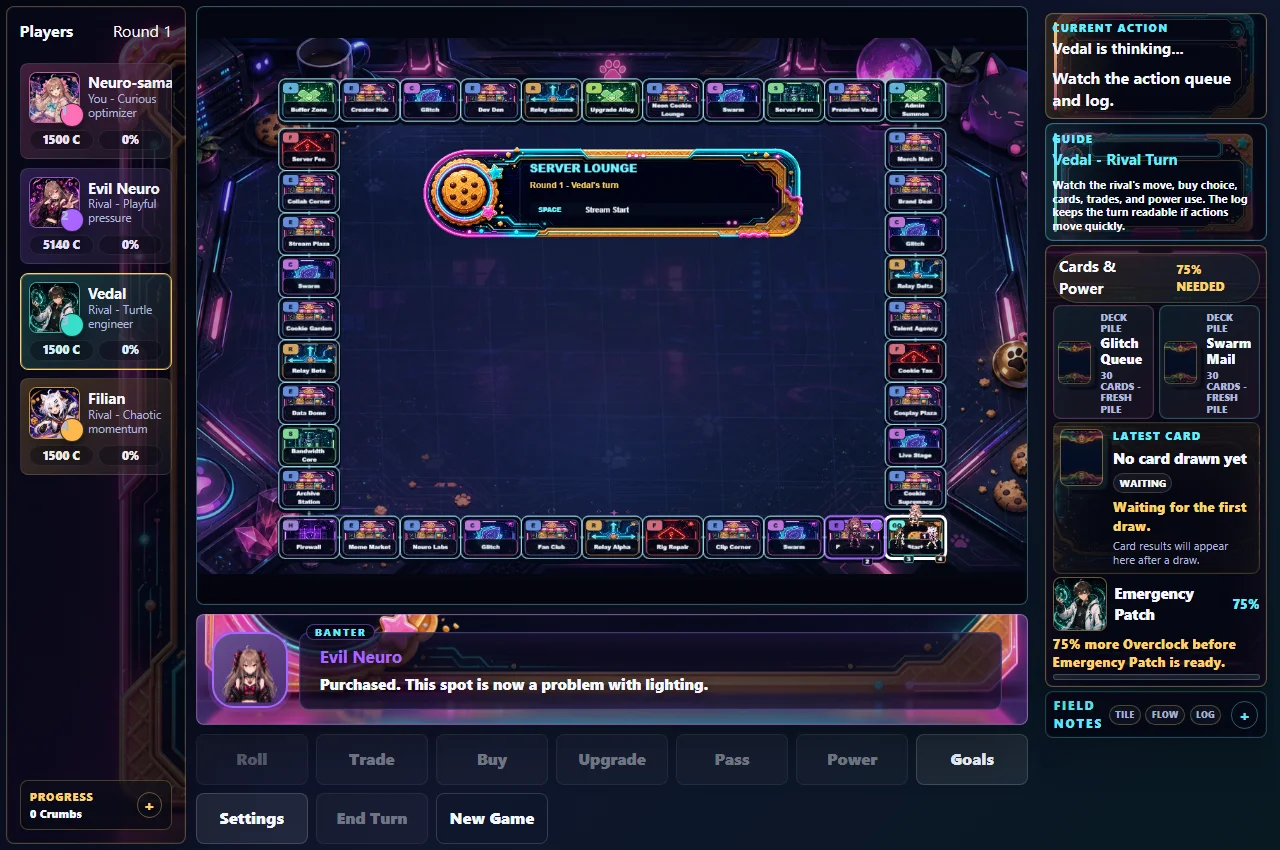
The rival screen lists four characters and you pick up to three to sit against you. This matters more than it looks. If you want a relaxed match, include Vedal. His AI profile keeps a 420-cookie buffer, so he buys rarely and trades patiently. If you want chaos, include Filian. Her profile runs a thin 180-cookie buffer and buys almost everything she lands on. Evil Neuro is the spiteful trader, Spring Neko the sneaky opportunist, and Neuro-sama the balanced all-rounder. Full personality numbers live in the Advanced section.
Your first board should always be Classic Circuit. It is a single loop with balanced estate values, and every strategy in this guide assumes it. The other boards change the rules; they get their own section below.
Step 3: Understand the Turn
Each turn has a simple flow: plan, then roll, then resolve the tile you land on, then end. You start with 1500 Cookies in Classic mode. Passing or landing on Stream Start pays 200 Cookies. The dice are two six-sided dice, so rolls of 6, 7, and 8 are your most common outcomes. Everything in the planning step happens before you roll: trade, upgrade, play a held card, or fire your power.
Core Mechanics
Estates, Sets, and Rent
The Classic Circuit board has 40 tiles. Twenty-one of them are estates organized into color sets. Owning every estate in a set doubles the rent on all of them. Owning at least two in a set gives a 1.35x bonus even before the set is complete, and each adjacent estate you own adds another 8%.
| Set | Estates | Cost / Rent |
|---|---|---|
| Pink | Byte Bakery, Clip Corner | 60 / 12-14 |
| Cyan | Fan Club, Neuro Labs, Meme Market | 100-120 / 18-22 |
| Violet | Archive Station, Data Dome | 140 / 26 |
| Orange | Cookie Garden, Stream Plaza, Collab Corner | 160-180 / 30-34 |
| Red | Creator Hub, Dev Den | 200-210 / 38-40 |
| Gold | Neon Cookie Lounge, Premium Vault | 240-260 / 46-50 |
| Green | Merch Mart, Brand Deal | 280-300 / 54-58 |
| Blue | Talent Agency, Cosplay Plaza, Cookie Supremacy | 320-400 / 64-80 |
The rent formula that matters: base rent × set multiplier × upgrade multiplier × adjacency bonus. A completed Orange set with a Level 3 Collab Corner collects 34 × 2 × 3.55 ≈ 241 Cookies per landing. One bad landing on that tile costs a rival more than a third of their starting stack. Upgrading one estate inside a completed set is the single most efficient way to grow income in the game.
The Full Classic Circuit Map
Forty tiles, indexed from Stream Start. Use this to plan routes, boosts, and deny plays.
| # | Tile | Type | Set | Cost | Base Rent/Fee |
|---|---|---|---|---|---|
| 0 | Stream Start | Start | - | - | 200 income / 100 landing bonus |
| 1 | Byte Bakery | Estate | Pink | 60 | 12 |
| 2 | Swarm Mail | Card | - | - | draw |
| 3 | Clip Corner | Estate | Pink | 60 | 14 |
| 4 | Rig Repair | Tax | - | - | 100 |
| 5 | Relay Alpha | Relay | - | 200 | 25 × relay count |
| 6 | Fan Club | Estate | Cyan | 100 | 18 |
| 7 | Glitch Queue | Card | - | - | draw |
| 8 | Neuro Labs | Estate | Cyan | 110 | 20 |
| 9 | Meme Market | Estate | Cyan | 120 | 22 |
| 10 | Firewall Hold | Hold | - | - | pause |
| 11 | Archive Station | Estate | Violet | 140 | 26 |
| 12 | Bandwidth Core | Service | - | 150 | 18 × last roll |
| 13 | Data Dome | Estate | Violet | 140 | 26 |
| 14 | Relay Beta | Relay | - | 200 | 25 × relay count |
| 15 | Cookie Garden | Estate | Orange | 160 | 30 |
| 16 | Swarm Mail | Card | - | - | draw |
| 17 | Stream Plaza | Estate | Orange | 170 | 32 |
| 18 | Collab Corner | Estate | Orange | 180 | 34 |
| 19 | Server Fee | Tax | - | - | 120 |
| 20 | Buffer Zone | Safe | - | - | rest |
| 21 | Creator Hub | Estate | Red | 200 | 38 |
| 22 | Glitch Queue | Card | - | - | draw |
| 23 | Dev Den | Estate | Red | 210 | 40 |
| 24 | Relay Gamma | Relay | - | 200 | 25 × relay count |
| 25 | Upgrade Alley | Patch | - | - | free upgrade chance |
| 26 | Neon Cookie Lounge | Estate | Gold | 240 | 46 |
| 27 | Swarm Mail | Card | - | - | draw |
| 28 | Server Farm | Service | - | 150 | 18 × last roll |
| 29 | Premium Vault | Estate | Gold | 260 | 50 |
| 30 | Admin Summon | Safe | - | - | rest |
| 31 | Merch Mart | Estate | Green | 280 | 54 |
| 32 | Brand Deal | Estate | Green | 300 | 58 |
| 33 | Glitch Queue | Card | - | - | draw |
| 34 | Relay Delta | Relay | - | 200 | 25 × relay count |
| 35 | Talent Agency | Estate | Blue | 320 | 64 |
| 36 | Cookie Tax | Tax | - | - | 160 |
| 37 | Cosplay Plaza | Estate | Blue | 350 | 70 |
| 38 | Live Stage | Card | - | - | draw |
| 39 | Cookie Supremacy | Estate | Blue | 400 | 80 |
A few things jump out of this map. The Cyan cluster (tiles 6-9) is the densest property run in the first third of the board, which is why it is the best early target. The Orange set (15-18) sits right after Relay Beta, and the stretch from tile 25 to 29 packs Upgrade Alley plus both Gold estates. The Blue set is spread across the end of the loop, and tile 36 sits between Blue pieces, so chasing Blue means eating a 160-cookie tax on the way.
Upgrades
Estates upgrade to Level 3. You unlock upgrades by completing a set or by owning a run of three adjacent estates. Upgrade costs scale with the property price:
Level 0 → 1: 55% of the estate's cost (min 40)
Level 1 → 2: 80% of the estate's cost
Level 2 → 3: 105% of the estate's cost
Each level multiplies rent by 1 + (level × 0.85). A Level 3 estate collects 3.55x base rent. The Upgrade Alley tile and certain cards (Power Surge, Patch Alley, Upgrade Cheer) interact with this system, so landing on or steering toward Upgrade Alley after completing a set is a strong play.
Relays and Services
Four relay tiles (Relay Alpha, Beta, Gamma, Delta) cost 200 each and pay 25 base rent, but relay rent multiplies by your total relay count. Two relays collect 50 per landing, three collect 75, and all four collect 100. Because relays ignore the set system and just count ownership, they are the best mid-game investment if you can buy two.
The two service tiles, Bandwidth Core and Server Farm, rent for 18 × the last dice roll total. They are weak on calm boards but scale with the pressure system late game, since pressure multiplies their payout too.
The Card Decks
Two decks, Glitch Queue and Swarm Mail, feed the card tiles. Card rarity odds are fixed: Common 60%, Uncommon 25%, Rare 12%, Legendary 3%. Most cards are "keep" cards that sit in your hand until you choose to use them before a roll. v1.0.1 reworked the system around exactly this: hold cards, spend them at the right moment, and trade them when a rival values one more than you do.
Glitch Queue deck:
| Card | Rarity | Effect |
|---|---|---|
| Cookie Drop | Common | Gain 90 Cookies |
| Minor Payout | Common | Gain 80 Cookies |
| Small Refund | Common | Gain 55 Cookies |
| Quick Patch | Common | Gain 35 Cookies, +10 Overclock |
| Hotfix Coin | Common | Gain 45 Cookies and a shield |
| Soft Reset | Common | Shield, +8 Overclock |
| Buffer Bump | Common | +2 on your next roll |
| Syntax Snack | Common | Roll one die and move that many |
| Trace Route | Common | Move to nearest Relay |
| Cache Ping | Common | Draw one Swarm Mail card |
| Cookie Probe | Common | Draw one Glitch Queue card |
| Router Fee | Common | Pay 70 Cookies, gain 18 Overclock |
| Latency Toll | Common | Pay 50 Cookies, gain 18 Overclock |
| Cache Miss | Common | Pay 60 Cookies, gain 20 Overclock |
| Dropped Packet | Common | Pay 40 Cookies, gain 14 Overclock |
| Reroute Fee | Common | Pay 80 Cookies, gain 22 Overclock |
| Backup Cookie | Common | Gain 50 Cookies, +50 more if you are last |
| Momentum Patch | Uncommon | +3 on your next roll |
| Relay Pull | Uncommon | Move to nearest Relay |
| Patch Alley | Uncommon | Move to Upgrade Alley |
| Emergency Buffer | Uncommon | Gain 75 Cookies and a shield |
| Catch-Up Script | Uncommon | Gain 85 Cookies, +75 more if last |
| Safe Mode | Uncommon | Move to nearest safe tile |
| Overclock Burst | Uncommon | Gain 28 Overclock |
| Crowded Cache | Uncommon | Everyone gains 25, you gain 35 more |
| Safety Buffer | Rare | Shield, +25 Overclock |
| Cookie Jackpot | Rare | Gain 160 Cookies, +60 more if last |
| Recovery Loop | Rare | Gain 120 Cookies and a shield |
| Power Surge | Rare | Upgrade one eligible estate for free |
| Golden Patch | Legendary | Claim a random rival estate; owner paid 180 Cookies |
Swarm Mail deck:
| Card | Rarity | Effect |
|---|---|---|
| Fan Mail | Common | Gain 60 Cookies |
| Kind Clip | Common | +2 on your next roll |
| Cookie Comment | Common | Gain 70 Cookies |
| Tip Jar | Common | Gain 80 Cookies |
| Cozy Cookie | Common | Gain 65 Cookies |
| Gift Cookie | Common | Gain 75 Cookies |
| Mod Nudge | Common | Shield, +10 Overclock |
| Clip Boost | Common | Gain 40 Cookies, +12 Overclock |
| Chat Charge | Common | Gain 20 Overclock |
| Signal Boost | Common | Gain 35 Cookies, +18 Overclock |
| Stream Snack | Common | Gain 45 Cookies and a shield |
| Safe Emoji | Common | Move to nearest safe tile |
| Lighthearted Detour | Common | Move to nearest Relay |
| Support Ping | Common | Gain 55 Cookies, +45 more if last |
| Kind Refund | Common | Gain 90 Cookies, +40 more if last |
| Small Hype | Common | Everyone gains 15, you gain 15 more |
| Micro Raid | Common | Everyone gains 20, you gain 20 more |
| Cookie Raid | Uncommon | Everyone gains 35, you gain 35 more |
| Collab Ping | Uncommon | Everyone gains 30, you gain 55 more |
| Lucky Chat | Uncommon | Gain 100 Cookies and a shield |
| Clip Train | Uncommon | Roll one die and move that many |
| Moderator Cover | Uncommon | Shield, +22 Overclock |
| Upgrade Cheer | Uncommon | Move to Upgrade Alley |
| Comeback Wave | Uncommon | Gain 100 Cookies, +90 more if last |
| Warm Signal | Uncommon | Draw one Swarm Mail card |
| Hype Train | Rare | Everyone gains 45, you gain 90 more |
| Rare Support | Rare | Gain 150 Cookies and a shield |
| Super Chat | Rare | Take 120 Cookies from the richest rival (80 if nobody qualifies) |
| Full Chat Focus | Rare | Roll two dice and move the total |
| Front Page Raid | Legendary | Claim a random unowned estate for free |
Patterns worth noticing. The Glitch Queue is the "engine" deck: it pays in Overclock, movement, and free upgrades. Swarm Mail is the "money and shields" deck. Both decks carry catch-up cards that pay double digits extra when you are last, so trailing players draw real comeback fuel. The two legendary cards are board-state changers: Golden Patch steals property, Front Page Raid claims any unowned estate for free.
Cards can also be traded. In v1.0.1, offering a held card as trade currency is often smarter than spending Cookies, because rivals value cards at fixed trade values between 70 and 160.
Overclock and Powers
Character powers run on Overclock, a second resource you build from card effects, tax tiles, and (on Subathon Spiral) patch spaces. Powers cost between 65 and 80 Overclock and go on a 2-turn heat cooldown after use. Overclock carries across laps, so holding cards that grant Overclock for a future power activation is a real strategy. Quick and Timed modes also inject Overclock every round from round 2 onward, which makes powers a bigger part of those modes.
Match Modes Explained
The three modes are not cosmetic variants. They change starting cash, income, multipliers, and the win condition, and each one rewards a different strategy.
| Setting | Classic | Quick | Timed |
|---|---|---|---|
| Starting Cookies | 1500 | 1200 | 1300 |
| Lap income (pass start) | 200 | 150 | 180 |
| Start landing bonus | 100 | 75 | 90 |
| Rent multiplier | x1.00 | x1.16 | x1.05 |
| Tax multiplier | x1.00 | x0.90 | x0.85 |
| Pressure system | Round 10+, +30%/round, cap x8 | None | None |
| Round limit | None | 10 | 8 |
| Elimination | Yes | Yes | No |
| Win condition | Last standing | Net worth, round 10 | Net worth, round 8 |
| Property value at finish | 0.8x cost | 1.0x cost | 1.0x cost |
| Upgrade value at finish | 45/level | 45/level | 45/level |
| Overclock pulse (round 2+) | None | Leader +2, field +5, trailing +5, behind-leader +2 (threshold 280) | Leader +4, field +9, trailing +8, behind-leader +3 (threshold 220) |
Three strategic consequences fall out of this table.
In Classic, property value counts at only 0.8x at the finish and pressure never stops climbing, so the mode hard-rewards owning and upgrading estates. Hoarding cash is how you lose a Classic match you were winning.
In Quick, rent flows 16% hotter and net worth counts property at full price, so aggressive early buying is correct. The round-10 cutoff means every lap is 10% of the game; there is no time to wait for perfect rolls.
In Timed, nobody gets eliminated and the field feeds you Overclock every round from round 2. Powers fire constantly. Filian and Neuro-sama, whose powers depend on board position, are at their best here.
The Four Boards
Classic Circuit is the 40-tile single loop mapped above. Balanced values, predictable traffic, and the mode where the pressure system lives. Learn this board first.
Festival Network branches. Transit hubs split the route into garden and stage paths, and a festival buzz meter runs from 1 to 5, peaking at 4, that pumps event tiles along the way. The lounge costs 35 Cookies, tables cost 15, taking a branch pays 8 Overclock, and trailing players get a 45-cookie catch-up. Strategy here is route arbitration: pick the branch that feeds your sets, and use the buzz meter to time when event tiles are worth hitting.
Subathon Spiral winds inward, and its patch spaces charge your Overclock. If you have been starving for power energy on Classic, this board feeds it. Powers fire far more often, which makes character choice matter more than property luck.
Corrupted Cloud mutates. Glitch events change tile states mid-match, and board corruption feeds directly into the rent formula (mode rent × pressure × corruption). Estates can get hotter or colder under your feet. Value flexibility here: sets you can complete in two laps beat monster sets you complete in five, because the board will not sit still that long.
Step-by-Step Match Strategy
Opening Phase (Laps 1-3): Buy the Board
- Buy every estate you can afford while keeping at least 300 Cookies in reserve. Bankruptcy is the only real loss condition in Classic.
- Target one set early and commit. The Cyan set (Fan Club, Neuro Labs, Meme Market) is the best first target because three estates sit close together in the first third of the board.
- Pass on expensive blue estates in the opening. Cookie Supremacy at 400 Cookies is a trap when you could buy two Cyan estates for the same money.
- Draw every card you land on. Early cards fund purchases and build Overclock.
- Buy relay tiles when you can. Two relays beat any single estate for passive income.
Mid Game (Laps 4-7): Upgrade and Trade
- Complete your first set, then upgrade one estate to Level 2 immediately. The 2.7x multiplier starts forcing rivals to respect your corner of the board.
- Open the trade screen and hunt set pieces. The trade panel shows estimated values, so you can see exactly what a rival property is worth before you negotiate.
- Offer cards instead of Cookies when you can. A held card plus 60 Cookies often closes a deal that pure cash would not.
- Watch the rival personalities. Vedal refuses risky deals, Filian overpays for set pieces she wants, Evil Neuro counters aggressively, and Spring Neko values safety.
- Build Overclock toward your power. If you are Neuro-sama, Predictive Peek at 70 Overclock lets you steer your next roll onto a set piece.
End Game (Laps 8+): Close It Out
- Push your primary set to Level 3. In Classic, rent pressure starts multiplying from round 10, so a Level 3 Orange or Gold estate becomes a knockout weapon.
- Deny the leader. If a rival owns two of three in a set, buy or trade for the third even if you do not need it. Blocking a completed set is worth the cost.
- Save shield cards for the leader's upgraded corner. One blocked payment can be the difference between surviving and elimination.
- Use your power at the moment it wins, not when it is convenient. Malicious Fork should hit the richest rival right before they would buy a set piece.
- In Quick and Timed, remember the win condition is net worth. Property counts at full value and upgrades add 45 per level, so hoarding cash into the last rounds loses to a player who converted cash into property.
Match Sequence Cheat Sheet
Classic (aim to win by round 12):
  Laps 1-3   Buy Cyan set pieces, keep 300+ reserve
  Lap 4      Complete Cyan set, upgrade Fan Club to L2
  Laps 5-6   Trade cards for Orange/Red set pieces
  Lap 7      Buy a second relay if available
  Laps 8-9   Upgrade primary set to L3
  Lap 10+    Deny leader's sets, shield your corner, collect rent

Quick (10-round net worth):
  Laps 1-2   Buy aggressively, rent is boosted 16%
  Lap 4      First upgrade (earlier than Classic)
  Lap 6      Convert cash into property; net worth counts 100%
  Lap 8      Stop trading with the leader
  Lap 10     Highest net worth wins, not most cash

Timed (8 rounds, no elimination):
  Every round  Counts. Buy property early, upgrade once, bank the rest
  Round 2+    Overclock pulse feeds powers; use Parkour Pivot to grab action tiles
  Round 7     Final conversion: spend cash on any remaining set pieces
Advanced Tips
The Pressure System
Classic matches hide a time bomb. From round 10, every round adds 30% to all rent and tax payments, up to a maximum of 8x. A match that runs to round 20 plays with 4x rents. This changes your strategy completely: passive players who banked cash instead of property get destroyed by the pressure multiplier, while property owners get richer every lap. In Classic, the correct play is almost always to own property. In Quick and Timed, pressure never activates, so cash hoarding is viable.
Traffic and Positioning
With two dice, rolls of 6, 7, and 8 account for 44% of all outcomes. Tiles roughly 6 to 8 spaces ahead of Stream Start (the Cyan set and Relay Alpha region) see the most landings per lap. Upgrading estates in high-traffic positions generates more rent per match than upgrading expensive estates in dead zones. The Blue set at the far end of the board is powerful but lands rarely early, which is why experienced players complete Orange and Green before touching Blue.
Reading the AI Table
Each rival plays by a fixed personality profile. The numbers below are the actual values the AI uses to decide purchases and trades:
| Rival | Cash Buffer | Risk | Spite | Generosity | Trade Patience |
|---|---|---|---|---|---|
| Vedal | 420 | 0.28 | 0.08 | 0.18 | 0.80 |
| Neuro-sama | 260 | 0.55 | 0.15 | 0.35 | 0.70 |
| Evil Neuro | 220 | 0.72 | 0.60 | 0.12 | 0.45 |
| Spring Neko | 230 | 0.66 | 0.20 | 0.25 | 0.50 |
| Filian | 180 | 0.82 | 0.28 | 0.22 | 0.35 |
The buy decision runs on this logic:
AI buys a tile when:  cookies - cost
  >= cashBuffer
   - 120 (if it already owns tiles in that set)
   - 55  x adjacent estates it owns
   - 90  (if the purchase creates a 3-estate run)
That means Filian will happily buy a 300-cookie estate with only 480 in the bank. Punish that: trade her the piece she needs, take her Cookies, then watch her fail the next tax tile. The reverse is also true: Vedal needs a huge surplus before any purchase, so he is the safest trading partner and the hardest player to bankrupt.
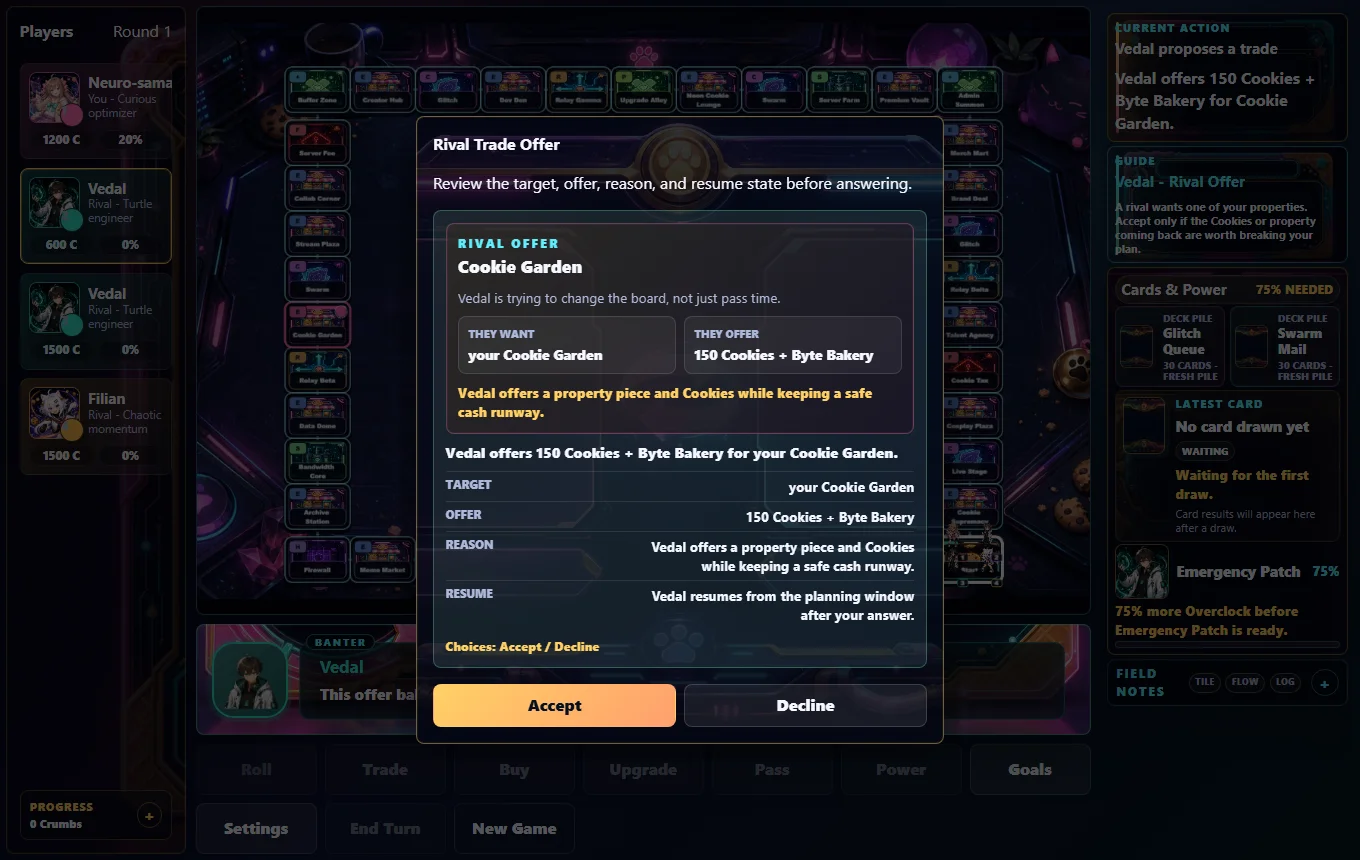
Trading has tells. Rivals open with reasons attached to offers ("sees value in that set and still keeps a safe cash runway"), and the trade dialog shows estimated values for every property on the table. Evil Neuro opened one observed match by offering 300 Cookies for a relay that cost 200, then escalated to cash plus a violet estate when refused. Accept escalation offers only when the property coming back beats what you are giving up.
Card Economy
Hold between 2 and 3 cards. Fewer than 2 and you have no answers; more than 4 and you are hoarding value that could be rent-generating property. Sell surplus cards early. A common card trades for 70 to 115 Cookies of value, which is often better than the 60 to 90 Cookies it would grant directly.
The strongest combo in the game: a shield card plus a completed set. Land on your own upgraded corner with a shield active and you collect rent while the shield waits for the next rival to arrive. On the other side, hold a boost card like Kind Clip until you are 2 to 3 spaces short of a set piece, then roll with +2.
Cards that pay extra when you are last (Backup Cookie, Catch-Up Script, Comeback Wave, Support Ping, Kind Refund) are worth more in a losing position than their face value suggests. If you are trailing, burn cash cards early and hold the last-place bonus cards until you actually are last.
The two movement families matter more than they look. Relay pulls (Trace Route, Relay Pull, Lighthearted Detour) hop you to income tiles, and Upgrade Alley cards (Patch Alley, Upgrade Cheer) convert a completed set into a free or accelerated upgrade. Holding one of each is a flexible default.
Goals, Secrets, and Cosmetics
Matches award Crumbs and XP for goals, and Crumbs buy cosmetics in the Bazaar. None of the cosmetics affect gameplay; they are pure drip for your pawn, nameplate, and UI. The goal list spans onboarding, property, trading, cards, character, board, and match categories, plus five secrets:
| Goal | Requirement | Reward |
|---|---|---|
| First Circuit Roll | Roll the dice in your first match | 75 Crumbs, 20 XP |
| First Node Claimed | Buy your first property | 100 Crumbs, 30 XP, badge |
| Back Around | Pass Stream Start | 100 Crumbs, 30 XP |
| Circuit Complete | Own a complete set | 160 Crumbs, 45 XP |
| Deal Maker | Get a trade accepted | 150 Crumbs |
| Table Regular | Complete 5 trades | Crumbs + XP |
| Inbox Active | Draw 10 cards | Crumbs + XP |
| Overclock Habit | Use powers 5 times | Crumbs + XP |
| Five Loops | Pass start 5 times in one match | Crumbs + XP |
| First Circuit Win | Win a match | Big payout |
| Secret: Boxcars | Roll a natural 12 | Badge |
| Secret: Premium Invoice | Collect a single rent of 200+ | Badge |
| Secret: Rare Signal | Draw 3 rare cards | Badge |
| Secret: Fully Patched | Upgrade an estate to Level 3 | Badge |
| Secret: Fast Circuit | Win a Quick match by round 10 | Badge |
Goals complete mid-match and pin to the side panel, so a single strong match can knock out the whole onboarding block. Premium Invoice is easiest with a Level 3 Orange or Gold estate in a pressure-late Classic match. Fast Circuit wants Quick mode with the aggressive opening described above.
Settings Worth Changing
Open Settings before your first match. Turn on color-safe token markers if you struggle to tell the four pawns apart on a bright board. Text size offers Normal, Large, and Extra Large, and reduced motion is available for accessibility. Audio defaults are fine: master 80%, music 70%, voices 80%, and every voice line can be muted independently.
Playing the Browser Build Smoothly
Cookie Circuit runs on Phaser with WebGL, so it wants a modern desktop browser. A few practical notes:
- If the board stutters, enable hardware acceleration in your browser settings and close other heavy tabs. The animated board background is the heaviest element.
- The itch.io embed can feel cramped on small windows. Fullscreen the page (the icon in the embed's corner) for the full layout.
- Progress (Crumbs, ranks, goals, cosmetics) persists between sessions. Mid-match state does not save, so budget 20 to 40 minutes for a full Classic match.
- No dedicated mobile build exists. The UI is mouse-first; touch works poorly on small screens.
- If the browser misbehaves, the 230 MB desktop download is the same v1.0.1 build and sidesteps embed quirks entirely.
Developer Background
Clord is a solo developer and Cookie Circuit is their fan-game project: an original board-game design starring a cast inspired by the Neuro-sama VTuber universe, with each character voiced and given distinct dialogue during matches. The build runs on Phaser 3.90.0, and the itch.io page discloses AI assistance for code, graphics, sounds, and text under Clord's direction. The project launched June 18, 2026, and v1.0.1 shipped the same day with a reworked card system and card trading. The page remains marked "in development," so more boards, characters, or systems may arrive; as of September 2026, v1.0.1 is the current build with no additional patch notes.
How It Compares
Next to classic property-trading board games, the skeleton is familiar: 40 tiles, color sets, rent, upgrades, bankruptcy. The differences are where the strategy lives:
- Powers and Overclock replace pure dice luck. A well-timed Predictive Peek or Emergency Patch is worth several properties over a match.
- Held cards create a second economy. Cards trade at fixed values, so your hand is a wallet.
- The pressure system puts a hard clock on Classic. Rent inflation up to 8x means late-game landings decide everything, and there is no equivalent in traditional property games.
- AI personalities are published numbers, not faceless opponents. You can play the cash buffers and risk values directly.
- It is singleplayer only. There is no online multiplayer; every match is you against up to three AI personalities at a local table.
- It is free, with cosmetics bought by earned Crumbs and no real-money store.
FAQ
Where do I play Cookie Circuit? Free in your browser at clord.itch.io/cookie-circuit. A 230 MB desktop download is also available.
How many players? You plus up to three AI rivals at a four-pawn table, picked from a bench of four characters.
How much does it cost? Free. Cosmetic unlocks cost Crumbs earned in matches, never real money.
How long is a match? 20 to 40 minutes. Quick mode is the shortest, Classic the longest.
What is Overclock? A resource built from cards, taxes, and some boards. Character powers spend it, then recharge over 2 heat turns.
What happens when a player goes bankrupt in Classic? They are eliminated. The match continues until one player survives or the others concede the net worth lead.
What is the difference between the three modes? Classic is open-ended with elimination and rising rent pressure after round 10. Quick ends at round 10 by net worth. Timed ends at round 8 by net worth with no eliminations and constant Overclock pulses.
Which character is best for beginners? Vedal. Emergency Patch is simple, and his cautious AI keeps rivals from snowballing too fast.
What is the fastest way to earn Crumbs? Complete onboarding goals in one match, then farm Deal Maker and trading goals in Quick mode, which finishes fast.
Does the game save progress? Crumbs, ranks, goals, and cosmetics save between matches. Mid-match state does not.
Is there online multiplayer? No. Every match is local: you versus AI rivals.
Does it work on mobile or Steam Deck? There is no dedicated mobile or Deck build. The browser version is playable on anything that runs a modern browser, but the UI is designed around a mouse.
Is the game still updated? The itch.io page is marked in development. v1.0.1 (June 2026) is the current build as of September 2026.
What is the single most important tip? Own property early. In Classic the pressure system punishes cash hoarders after round 10, so convert Cookies into estates, complete one set, and let rent plus pressure do the killing.