Official game
Play Shardbreakers
This game is hosted by Steam. Continue to the official page to play or download it.
Wishlist on SteamOverview
Shardbreakers is a bullet-hell action roguelite from Embercore, a small studio building the game around one idea: you do not find combos, you design them. Every attack in the game comes from Shards, socketed pieces of magic that you combine into lanes. Your weapon fires automatically, lighter spells trigger themselves, and your biggest nukes wait on manual input. The result plays like a twin-stick bullet hell crossed with a granular Path of Exile-style crafting board.
The story setup gives the shard system its name. The Breakers shattered the First Light, the origin of all creation, and stole its Shards to fuel their rule. You play one of three heroes descending into hand-crafted realms swallowed by darkness, reclaiming raw Shards and turning them into increasingly absurd spell engines.
The full game targets January 2027, and a new demo drops in October. The current demo already shows the whole loop: socket shards, fight through a biome, watch your engine cascade, die, unlock, repeat. This guide covers what works in the demo and what the system implies for the full release.
| Fact | Detail |
|---|---|
| Developer / Publisher | Embercore |
| Genre | Bullet-hell twin-stick action roguelite with deep buildcraft |
| Platform | Windows (Steam) |
| Release date | January 2027; new demo planned for October 2026 |
| Heroes | Hunter, Arcanist, Knight |
| Shard types | Skill, Modifier, Condition |
| Skill elements | Fire, Ice, Lightning, Arcane, Physical |
| Structure | Hand-crafted biomes, procedurally generated runs, permadeath |
| Meta progression | Permanent upgrades, expanding skill trees, unlockable heroes |
| Community | Discord linked on the official site |
Who it is for: players who loved the socketing in Path of Exile, spell-crafting fans who wanted Noita's depth without the pixel simulation, and twin-stick players who want their dodging to matter because their build took twenty minutes to design.
Who it is not for: players who want a curated upgrade pool with three choices per level. Shardbreakers hands you a blank board and expects you to think.
Getting Started
Wishlist the game on Steam and grab the demo when the October build goes live. The previous demo ran through two biomes and three heroes, and the October demo rebalances around the rebuilt engine.
Your first session plan
- Pick the Hunter for run one. The swift hero has the most forgiving movement, and bullet hells punish slow characters hardest while you are still reading enemy patterns.
- Socket one lane and test it before adding more. New players stack five shards, trigger nothing, and die confused. One skill shard plus one modifier gives you a readable result you can iterate on.
- Read the interaction preview. The board shows what a shard combination does before you commit it. The demo's pause menu lets you rearrange lanes mid-run, so nothing is permanent until you leave the board.
- Save your manual slot for your heaviest spell. The automatic lane handles chaff. Your manual cast should be the spell that deletes an elite or unloads into a boss.
- Treat the first death as data. Permadeath ends the run, but permanent upgrades carry over. You are supposed to lose early runs while you learn which interactions chain.
Beginner mistakes to avoid
- Ignoring Condition Shards. They look passive, but conditions are what turn two skills into a combo. A skill that fires on freeze, paired with an ice skill, doubles your output without touching damage numbers.
- Overloading lanes early. Every shard you socket has an opportunity cost. A clean three-shard engine outperforms a messy six-shard board where nothing triggers in order.
- Standing still during cascades. The board does the damage; you do the dodging. Chained spells clear screens, but only if you survive long enough for the chain to resolve.
- Skipping hero unlocks. The Arcanist and Knight change how builds work, not just their stats. Locked heroes mean locked build archetypes.
- Fighting the bullet density with reflexes alone. This is a build-crafting game first. If a biome walls you, the answer is usually a different engine, not faster hands.
Core Mechanics
The spell engine: lanes, slots, and triggers
Each lane is a row of slots. Skill Shards define what a spell does, drawn from Fire, Ice, Lightning, Arcane, and Physical. Modifier Shards change how a skill behaves: more projectiles, wider spread, faster travel. Condition Shards decide when things fire, and they are the glue that turns separate lanes into one machine.
Your weapon attacks automatically. Lighter spells trigger on their own once socketed. Your most decisive spells stay under your control. That three-tier authority split is the core design: the game plays itself at the bottom end, while you reserve attention for the decisions that matter.
The official site's framing is worth internalizing: interactions trigger, chain, and reshape one another. A fire bolt that explodes on kill, into a condition that casts lightning on explosion, into an arcane wave on every third lightning strike. The demo rewards sitting in the pause board, reading your lanes left to right, and asking what triggers what.
The five elements and what they do
Fire burns and spreads. Ice controls, freezing and setting up shatter interactions. Lightning chains between targets. Arcane bends the rules of the other four. Physical anchors the board with reliable, positional damage. The demo does not publish exact numbers, but the behavioral identity holds across builds, and conditions that key off specific states, like frozen or burning, are where the elements start talking to each other.
Heroes change the foundation
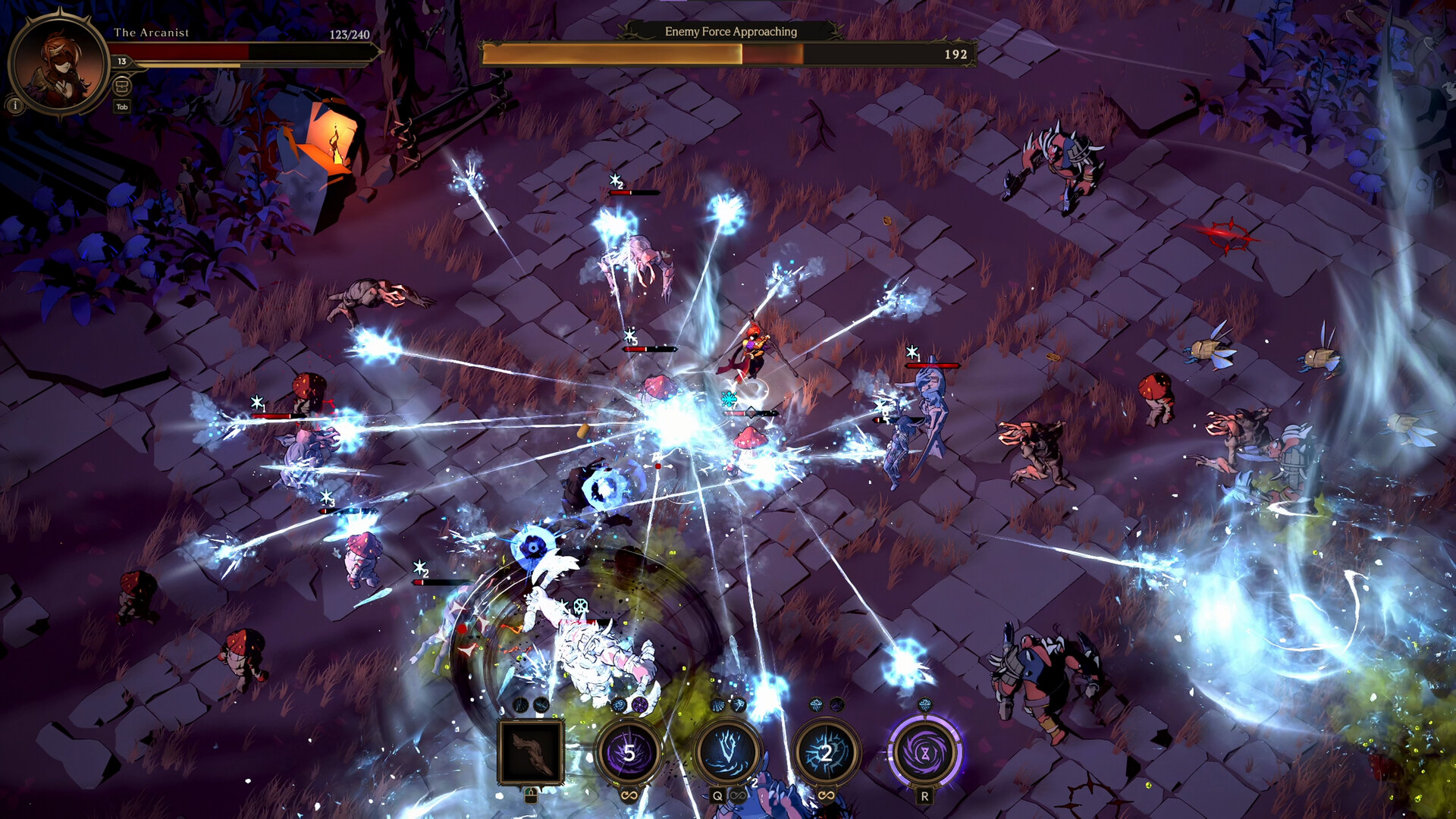
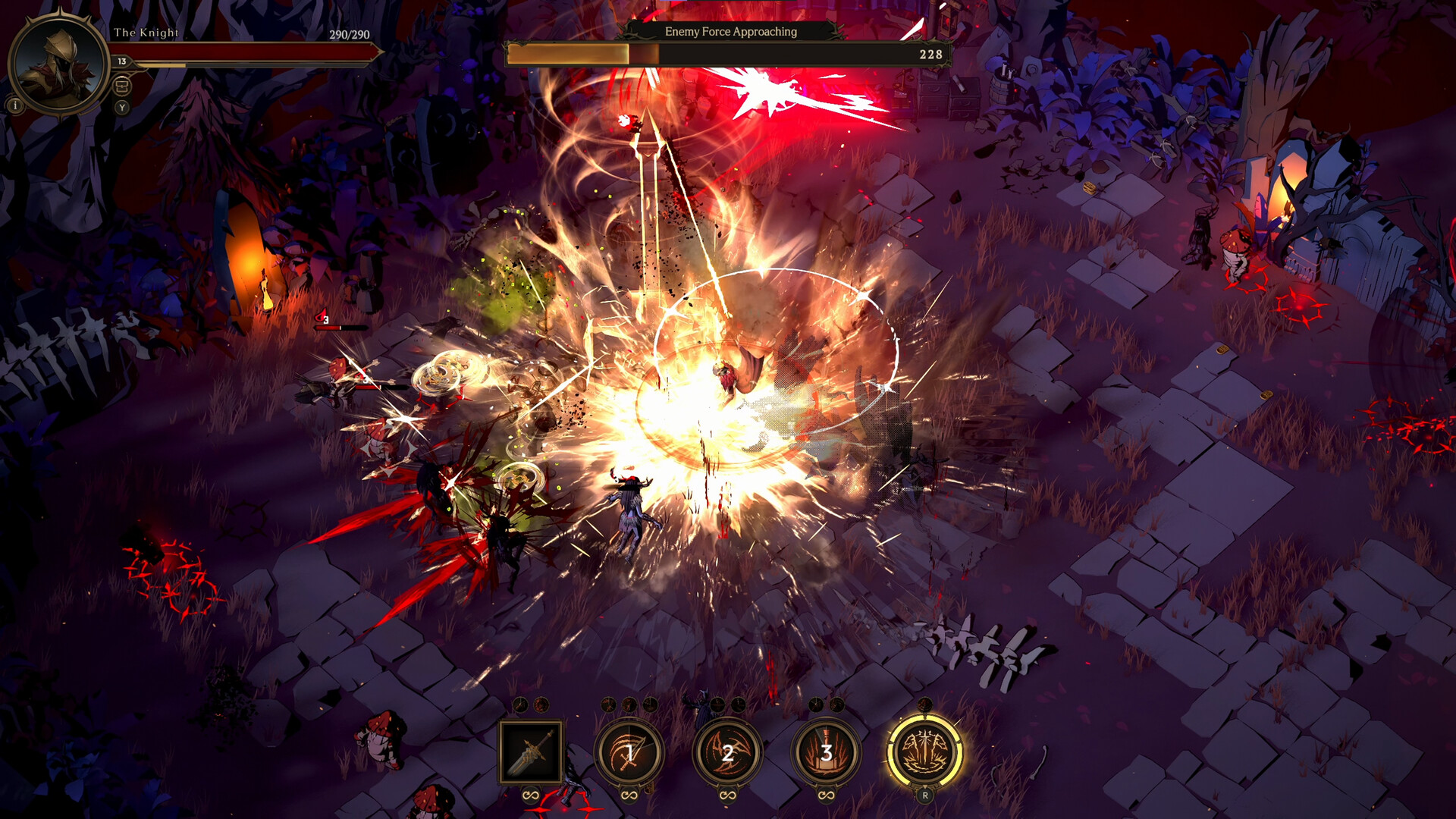
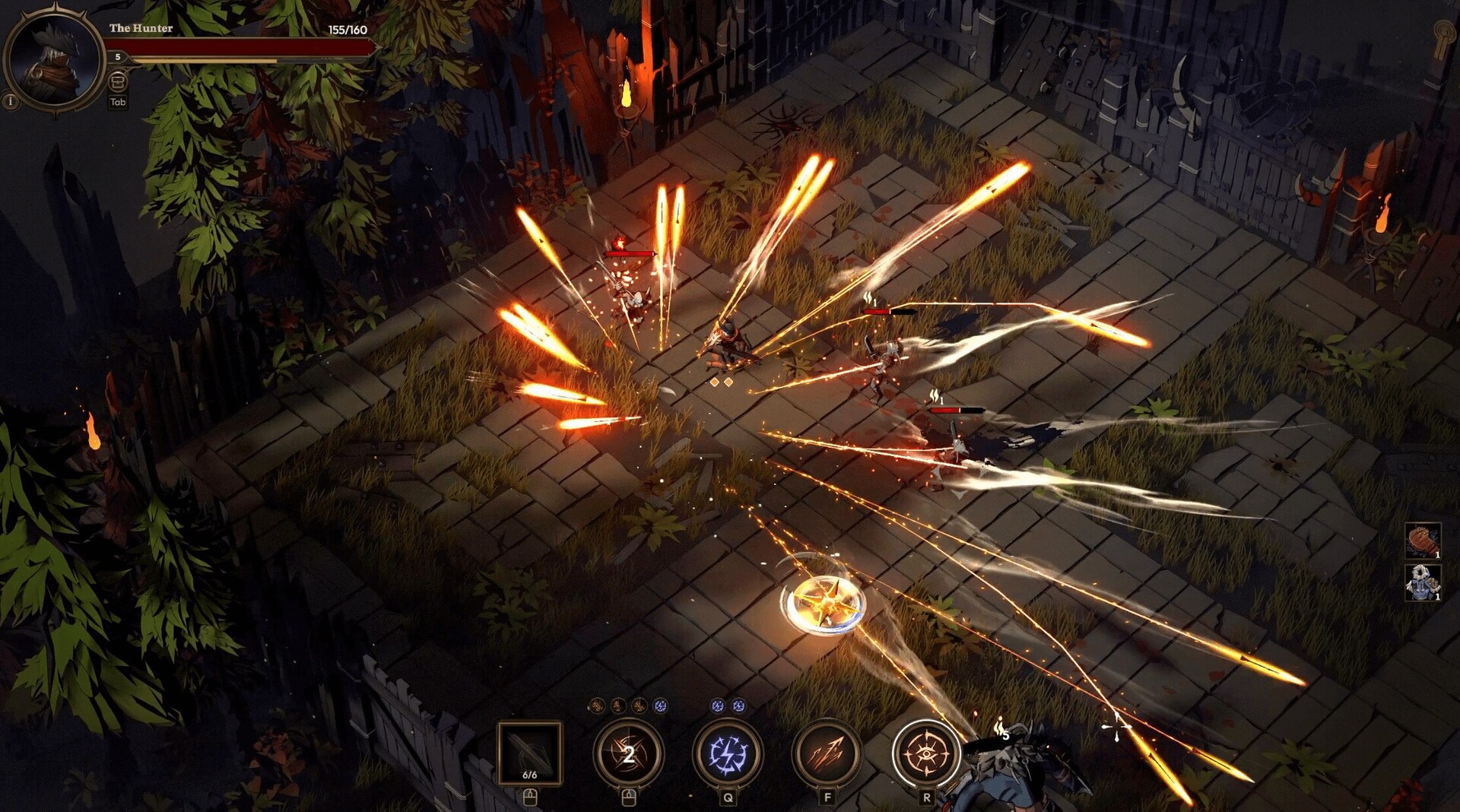
The Hunter, Arcanist, and Knight each bring a distinct weapon, resource, and way to shape a build. The Hunter plays fastest and rewards aggressive repositioning. The Arcanist leans into raw spell output and synergy density. The Knight trades speed for durability and anchor-style physical builds. Embercore describes them as foundations: the same shard pool behaves differently depending on who carries it.
Pick your start with the hero that matches how you like to dodge, then shape each run through the engine you build. Unlock new shards, change the trigger, change the arrangement, change the result.
Combat density as fuel
A crowded battlefield is not just danger. It is fuel for a working build. Every chain condition in the game reads enemy states: on kill, on freeze, on hit streak. Hordes feed your engine. The counterintuitive skill to learn is standing in the right pocket, letting density trigger your cascades, and dodging only the patterns that actually threaten you.
The bullet-hell layer stays honest. Uniquely designed enemies carry their own movement patterns, attack behaviors, and tactical roles, combined with environmental hazards. Encounters feel authored rather than randomly thrown together, which matters because your build experiments need readable inputs to evaluate.
Run structure and permadeath
Runs descend through hand-crafted biomes with procedurally generated layouts. Permadeath ends the run, and permanent upgrades, expanding skill trees, unlockable heroes, and meta resources fuel the next descent. Overage-Gaming's demo write-up put it well: every return to the surface gives the next run purpose. The loop respects your time even when it kills you.
Bosses gate biome exits. They are where manual-cast discipline pays off, because a boss dodge window is exactly long enough for one well-timed engine cycle.
Advanced Tips and Strategies
Design engines, not spells
The single biggest skill jump is thinking in engines. A spell answers "what do I throw?" An engine answers "what happens when X meets Y, and what does that trigger?" Build two small engines that cover different ranges rather than one overbuilt lane. Redundancy beats peak damage when a biome counter picks off your main interaction.
Layer conditions in sequence
Chains resolve in order. A condition that checks for burning works better one lane after your fire application than simultaneously with it. If a cascade whiffs, the usual culprit is ordering, not power. Read the board left to right, match it against what happened on screen, and move one shard.
Budget your manual casts
Manual slots recharge on their own rhythm. New players dump them on cooldown. Advanced play holds the cast for elite spawns, pack breaks, or the moment a boss enters a vulnerability window. The difference between a good run and a great one is often three well-timed casts.
Hero-shard alignment
Match your lane design to your hero's rhythm. Hunter builds want instant, mobile triggers that fire while repositioning. Arcanist builds want cascading chains that compound during stationary casts. Knight builds want proximity conditions and physical anchoring. Fighting your hero's core tempo is the most common reason a theoretically strong board underperforms.
Demo-first build experiments
The October demo is the testing ground for full-release builds. Write down your two best engines before a new patch lands. Balance changes to trigger order or modifier scaling can invalidate a favorite combo, and having a record of what worked lets you retest fast instead of rediscovering from zero.
Beginner's Guide: First Demo Session
- Start on Hunter, one lane, two shards. Walk before you cascade.
- Keep the pause board open in your first fights. Reading interactions in slow motion trains you for real-time reads.
- Pick up every raw Shard. The reclaim economy funds unlocks between runs.
- Die on purpose once. Push a dumb build into a biome you cannot clear and watch which interaction carries the furthest. Failure data is build data.
- Join the Discord. Embercore has been quiet publicly while rebuilding the game, and the community channels carry the current patch context.
The Shard System in Depth
The board is the game. Three shard types, five elements, lanes with endless arrangement possibilities. The demo's rebuild, teased on the Embercore X account with the line "Shardbreakers hasn't been quiet," points at trigger logic as the active development focus. Expect the October demo to shuffle how conditions resolve.
What makes the system deep rather than busy:
- Modifiers compose. A projectile modifier stacks with a split modifier stacks with a burn modifier. Power compounds instead of replacing.
- Conditions create dependencies. Once one lane feeds another, your build has internal logic. Protecting that logic becomes the run's strategic layer.
- Authority is tiered. Automatic weapon, auto-triggering light spells, manual nukes. You scale your attention with your build's complexity.
The comparison set matters for expectations. This is closer to Path of Exile's socket puzzle than to Vampire Survivors' passive collection. If you want the game to play itself, lighter engines do that. If you want to engineer a screen-wide thunderfall from a single hit, the ceiling is there.
World, Story, and Setting
The Breakers shattered the First Light, the origin of creation, and its Shards now fuel their grip on the world. You descend into realms swallowed by darkness as one of three heroes, reclaiming raw Shards before the corruption sets them permanently. The narrative is light-touch framing for the loot loop, but it explains the game's core verb: everything you pick up is a piece of something whole, and your power grows by reassembling it your way.
Hand-crafted biomes give each descent a themed identity, with unique enemy designs and environmental hazards per region. The art direction runs isometric, high-contrast, and readable at bullet-hell density, which is a harder balance than it sounds.
System Requirements
Steam has not published minimum specifications for the final build. The demo runs on modest Windows hardware at 1080p, and the isometric presentation keeps its GPU demands well below the 3D action average. Check the Steam page for updated requirements when the October demo lands.
Steam Deck and Platform Notes
Shardbreakers is listed for Windows only so far. There is no confirmed Steam Deck support, and no ProtonDB report exists for the current demo. Twin-stick controls with a manual-cast layer map naturally to a controller, so Deck compatibility is plausible but unverified. Treat it as unknown until Embercore confirms.
Monetization and Pricing
No price announced. The game is a standard premium Steam release with a free demo, no early access phase announced so far, and no microtransactions visible in any store material.
Community and Links
- Official site: shardbreakersgame.com, with press kit and contact for streamers and journalists
- Discord: linked from the official site, the main hub for playtest news
- Steam page: store.steampowered.com/app/3256040
- X / Twitter: @EmbercoreGames posts build updates and trailer drops
- YouTube: the official demo trailer plus a healthy wave of creator coverage, including gameplay deep dives passing 15K and 90K views
Known Issues and Open Questions
- The engine rebuild means demo impressions from April 2026 may not match the October demo. Balance notes and trigger behaviors are explicitly in flux.
- Steam reviews are zero so far, which is expected for an unreleased title but means community build knowledge is scattered across Discord and YouTube rather than consolidated.
- Full release content beyond the three heroes and current biome set has not been detailed. Embercore has promised more than it has shown.
Roadmap
The confirmed near-term milestone is the October demo drop, with wishlisters getting access the day it goes live. January 2027 is the launch window. Between now and then, watch the X account for rebuild notes and the Discord for playtest signals. Embercore's slow, quiet patching cadence suggests a studio polishing trigger systems rather than rushing content.
Comparison With Similar Games
| Game | What it shares | Where Shardbreakers differs |
|---|---|---|
| Path of Exile | Socket-driven skill linking, condition chains | Real-time twin-stick combat instead of ARPG movement |
| Noita | Spell composition depth, emergent combos | Isometric bullet hell instead of pixel physics simulation |
| Halls of Torment | Bullet-hell horde pressure, run-based loops | Shardbreakers puts crafting authority in your hands, not a random pool |
| Dead Estate-style twin sticks | Dodge-focused combat reading | Your engine, not your reflexes, is the primary damage source |
FAQ
Is Shardbreakers out? No. It targets January 2027, with a new demo planned for October 2026.
How much will it cost? No price announced yet.
Is there a demo? Yes, a previous demo ran through two biomes, and a rebuilt demo arrives in October. Wishlist on Steam to catch it day one.
Is it multiplayer? No. It is a single-player action roguelite.
Is it on Steam Deck? Unconfirmed. Windows is the only announced platform.
Is this like Vampire Survivors? It shares horde-combat DNA, but the shard system makes it a deliberate build-crafting game. Passive players can run light engines; tinkerers get a crafting board with a very high ceiling.
Who makes it? Embercore, an independent studio self-publishing the title.
Quick Reference Card
| System | What to know |
|---|---|
| Skill Shards | Fire, Ice, Lightning, Arcane, Physical |
| Modifier Shards | Change projectile count, spread, speed, behavior |
| Condition Shards | Set triggers: on kill, on freeze, on chain |
| Heroes | Hunter (swift), Arcanist (synergy), Knight (durable) |
| Manual casts | Save for elites and boss windows |
| Permadeath | Ends the run; permanent upgrades persist |
| Demo | October 2026 rebuild |
| Launch | January 2027 |
Screenshots