Official game
Play Ruins of Enreggel
This game is hosted by itch.io. Continue to the official page to play or download it.
Play on itch.ioOverview / Game Introduction
Ruins of Enreggel is a free browser-based base-disassembly survival strategy game that flips the city-builder genre on its head. Instead of building a settlement from scratch and defending it, you start with a fully constructed village and must systematically dismantle it, evacuate your villagers through dimensional portals, and flee before the supernatural Grim mist consumes everything.
Developed by speratus (Andrew Luchuk) for the Redot Spring Game Jam 2026, the game was inspired by a simple question: what if a strategy game made you tear down a base instead of build one? The game jam version was completed after the deadline, then polished into a full playable experience. It runs entirely in the browser with no download required.
| Detail | Info |
|---|---|
| Genre | Strategy / Survival / Base-Disassembly |
| Developer | speratus (Andrew Luchuk) |
| Engine | Redot (Godot fork), Web build |
| Platform | Browser (itch.io) |
| Price | Free |
| Players | Single-player |
| Version | 0.1.0 (Game Jam Entry) |
| Difficulty | Medium — punishing if you mismanage resources, forgiving once you understand the rhythm |
| Session Length | 15–30 min per cycle, repeatable with escalating difficulty |
Target audience: Players who enjoy resource-management puzzles, base-building games where planning matters more than speed, and survival games with a unique twist. If you liked Frostpunk's "the storm is coming" pressure or Banished's resource balance, this game's "reverse city-builder" concept will click immediately.
The core loop is simple to describe but hard to master: survey the settlement, assign workers to harvest four resource types, complete the King's objectives for gold, use that gold to disassemble buildings, open the portal with Portalium, evacuate villagers, and flee before the mist arrives. Then repeat on a procedurally repositioned map with increasing difficulty.
Getting Started — First 30 Minutes
What You See
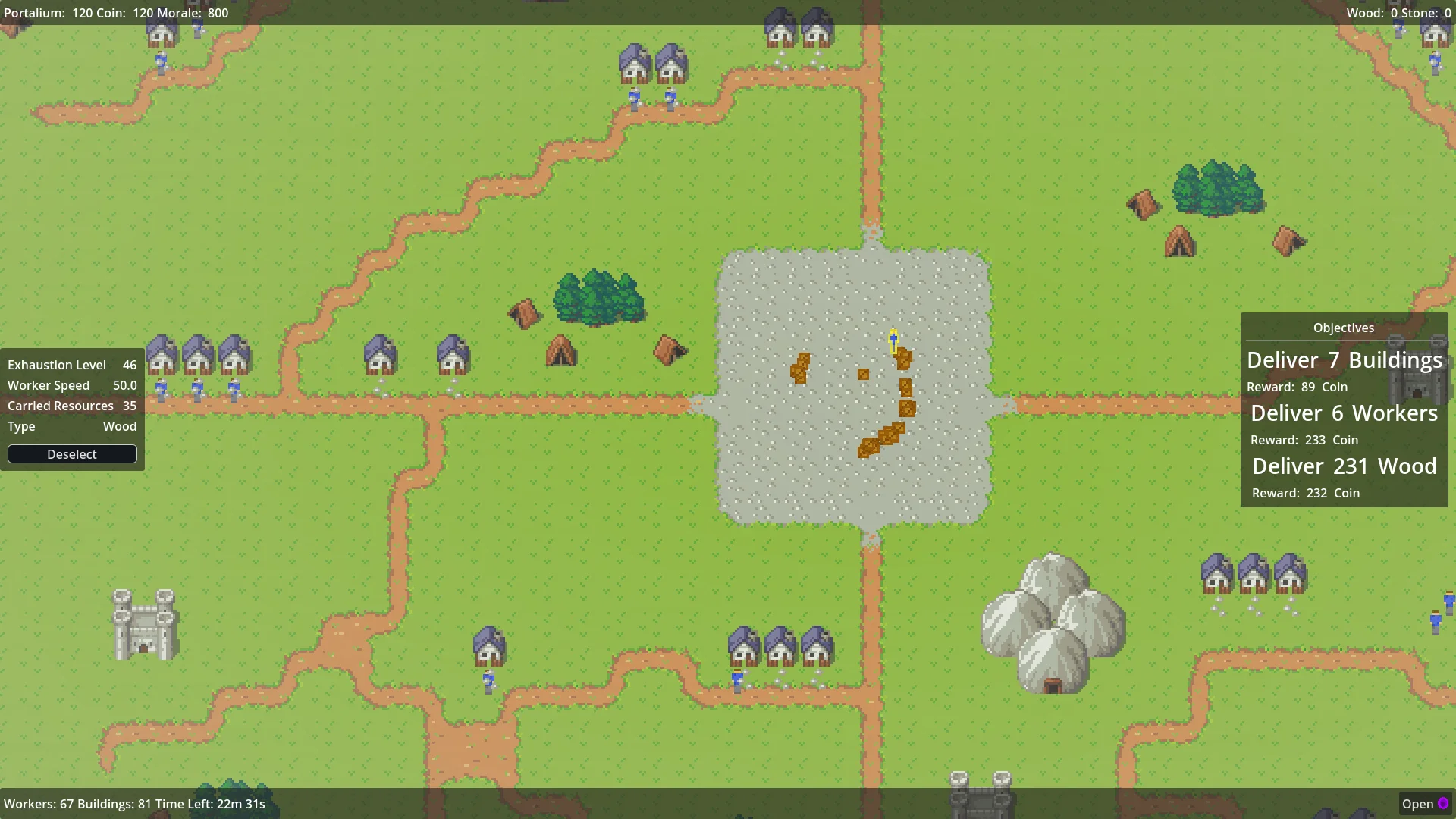
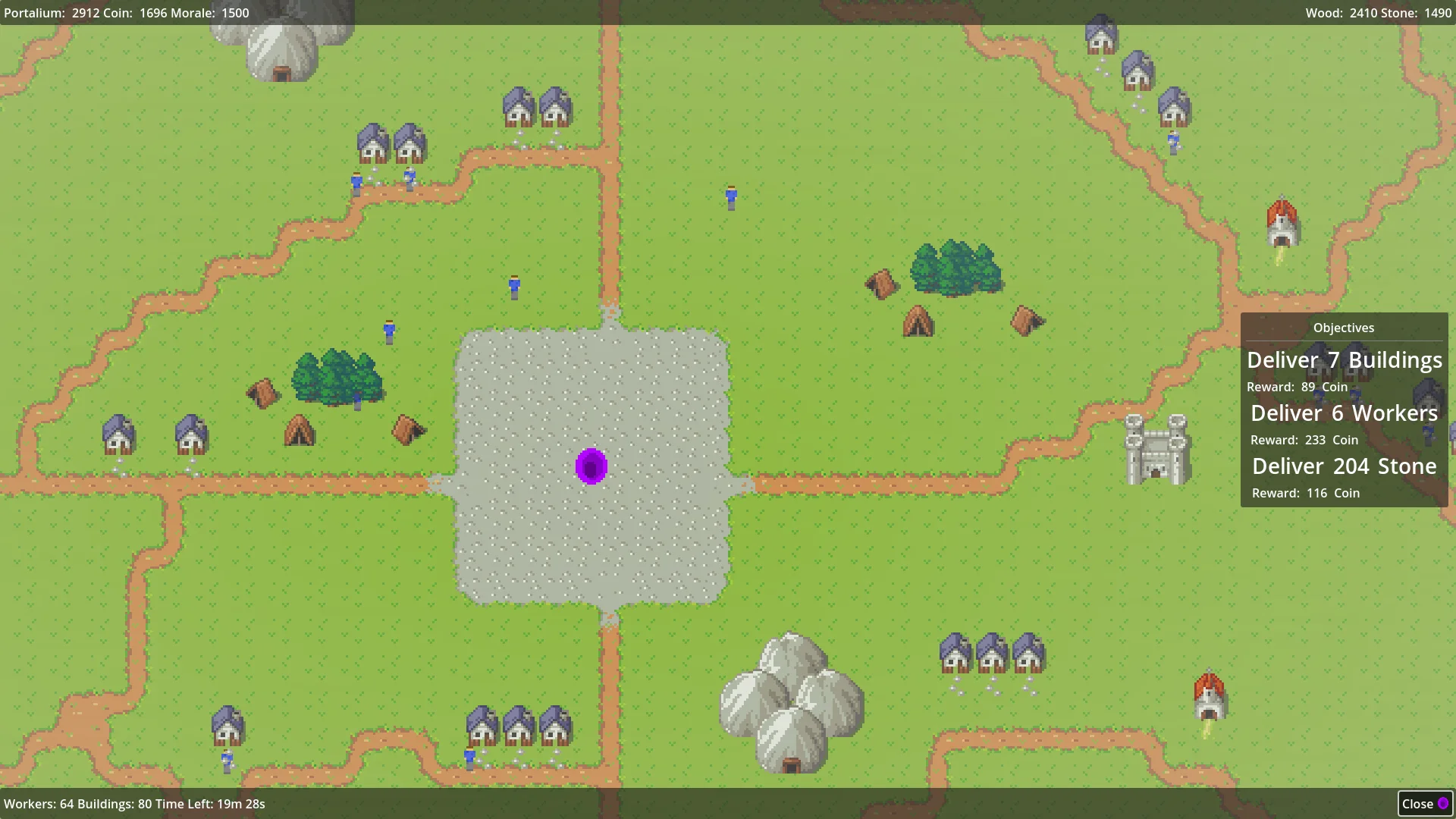
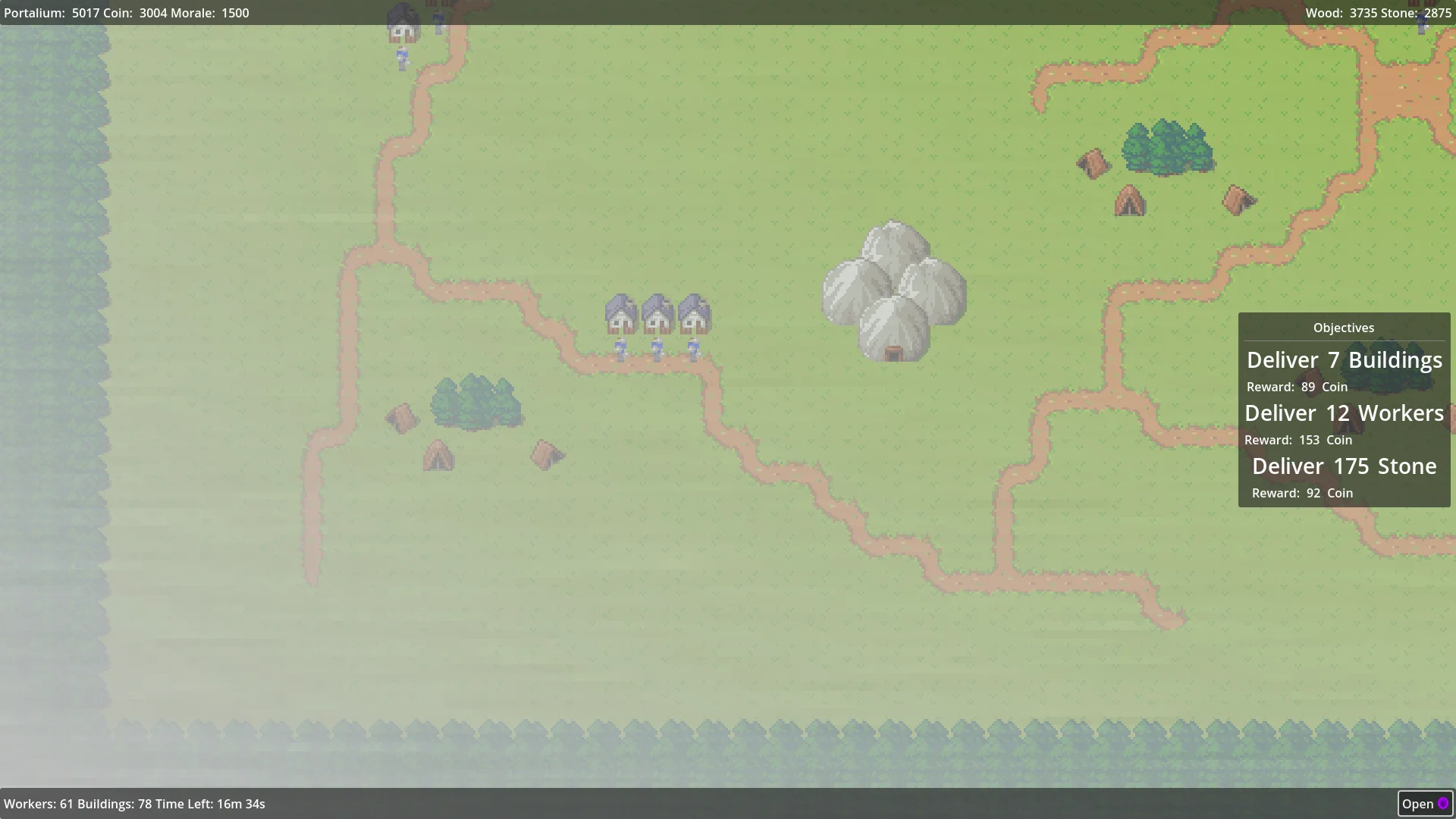
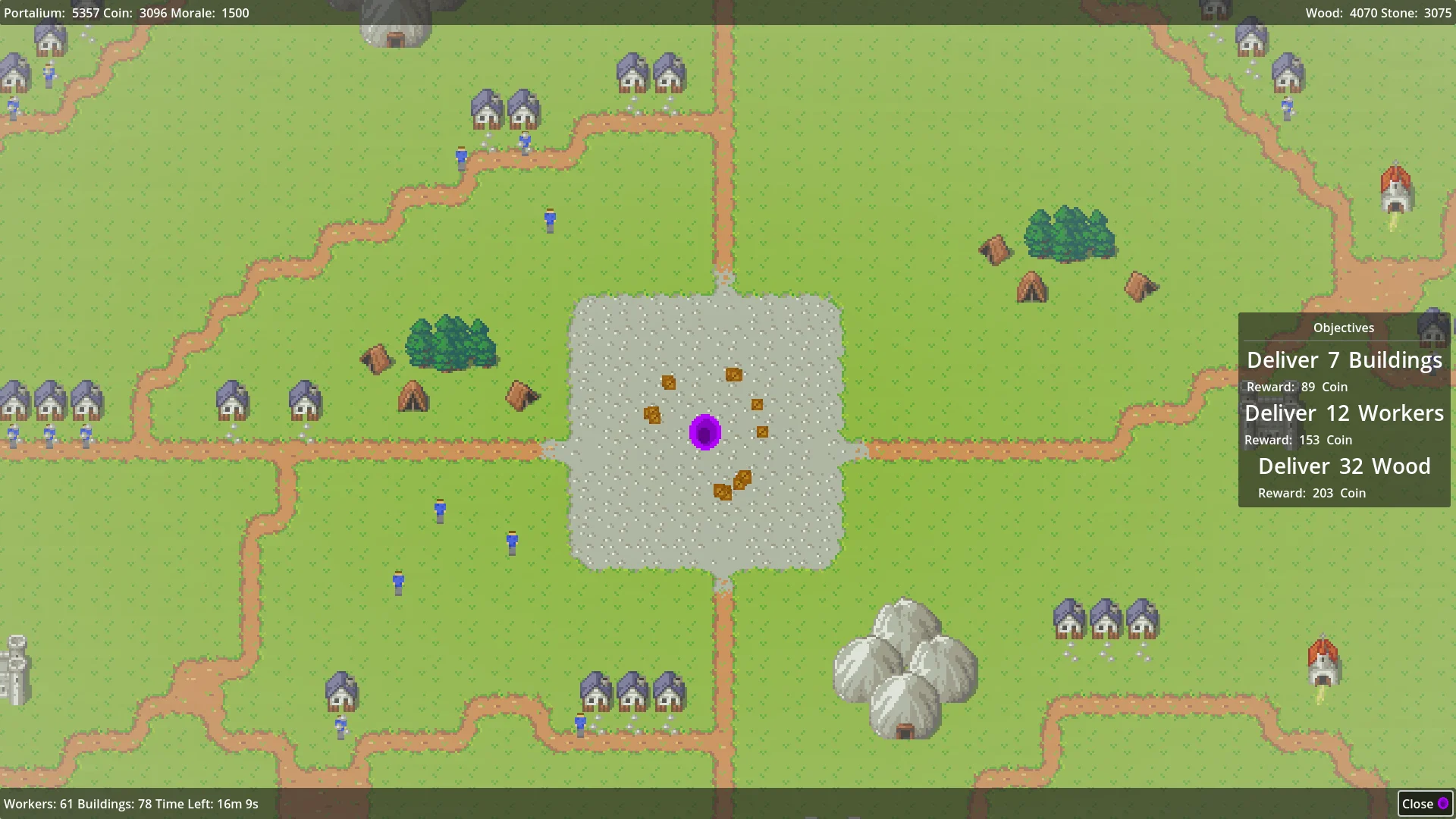
The game drops you into a top-down settlement viewed from above, looking down at buildings scattered around a central glowing portal. A status bar at the top tracks your four resources — Wood, Stone, Portalium, and Morale — plus your gold coin count and the number of workers. The King's objectives appear as a panel on the right or bottom. The Grim mist is visible as a dark haze creeping from the edges of the map.
Workers wander autonomously. They can be selected by clicking on them. Buildings are interactable — click one to see its options.
Critical First Moves
1. Survey the layout before touching anything. Pause immediately with Escape. Identify:
- Where are the resource nodes? Forest Groves (wood), Mountains (stone), Churches (morale), Castles (portalium)
- Where is the dimensional portal?
- Which buildings are furthest from the portal? These will be consumed by the mist first.
- How many houses exist? Each house has a fixed number of sleep slots.
2. Assign workers to Castles first. Portalium is the single most important resource. Without it, your portal cannot open and you cannot evacuate. Assign 2 workers to Castles before anything else.
3. Check the King's first objective. The King's requests are your primary source of gold. Gold is the bottleneck for disassembly — you need it to dismantle buildings. Match your worker assignments to the first objective.
4. Do not open the portal prematurely. The portal costs Portalium continuously while active. Wait until you have stockpiled 50+ Portalium and most buildings are already disassembled. Opening too early drains your reserve and can end the run.
Beginner Mistakes to Avoid
| Mistake | Why It Hurts |
|---|---|
| Opening the portal too early | Drains Portalium continuously. If you run out mid-evacuation, the portal closes permanently — instant game over. |
| Disassembling buildings without gold | Each disassembly costs coins. If you run out mid-cycle, buildings get consumed by the mist and morale drops. |
| Ignoring morale | Low morale slows worker movement speed. Slow workers → fewer resources per minute → cascading failure. |
| Putting houses far from the portal | Exhausted workers must walk to houses, sleep, walk back. Long travel times cut resource throughput in half. |
| Spreading workers across too many resource types | Focus-fire one resource at a time. Workers assigned to 4 different nodes accomplish less than 4 workers at 1 node. |
Core Mechanics Explained
The Reverse City-Builder Loop
Ruins of Enreggel operates on a repeating cycle:
Survey → Harvest → Complete King's Objectives → Disassemble Buildings → Open Portal → Evacuate → Repeat
The game inverts the standard city-builder formula. You gather resources not to construct, but to deconstruct. Every building you successfully disassemble in one cycle can be rebuilt in the next settlement. Buildings lost to the mist are gone permanently. This creates a tense risk-reward calculation with every building you choose to save or sacrifice.
The Grim Mist — Your Countdown Clock
The mist advances from the map edges toward the portal at a steady, deterministic pace:
- Advance speed is fixed — it does not accelerate or slow down
- Buildings furthest from the portal are consumed first
- Any building or worker consumed by the mist causes morale to drop
- If the mist reaches the portal before all villagers are evacuated, the game ends with the message: "The grim fog consumed your domain."
Key strategic insight: The distance from a building to the portal determines how much time you have before that building is consumed. Work from the perimeter inward. The buildings closest to the portal are your last priority.
Worker AI & Exhaustion System
Workers are autonomous agents with a specific behavioral loop:
Move to resource node → Harvest → Check exhaustion → If tired, seek nearest house → Sleep → Return to portal → Repeat
Exhaustion mechanics in detail:
- Workers accumulate exhaustion per harvested resource and per unit of distance traveled
- Once exhaustion exceeds the tired threshold, carry capacity drops significantly (approximately 50% less per trip)
- Each house has a max_sleep_slots value (number of beds). If all beds are occupied, exhausted workers cannot rest and remain in a low-efficiency state
- A well-rested worker moves 2x the resources per trip compared to an exhausted one
Carry capacity: Each worker has a base carry_capacity stat. Exhaustion reduces this proportionally. This means an exhausted worker makes more trips (spending more time walking) to deliver the same amount as a rested worker.
Resource System
| Resource | Source Building | Primary Use | Critical Notes |
|---|---|---|---|
| Wood | Forest Grove | Rebuilding infrastructure next cycle | Harvest early, stockpile for the next settlement |
| Stone | Mountain | Rebuilding infrastructure next cycle | Second priority after Wood |
| Portalium | Castle | Keeps the dimensional portal open | Most important resource. If this hits zero with the portal open, the game ends. |
| Morale | Church | Increases worker movement speed | Acts as a global speed multiplier. Low morale = slow workers = death spiral. |
Gold Economy
Gold coins are the bottleneck resource for disassembly:
- Earned exclusively through completing the King's objectives
- Each objective requires delivering a specific amount of a resource
- Disassembling a building costs a fixed amount of gold (varies by building type)
- If you try to disassemble without enough gold, the game shows "You do not have enough coin"
Critical rule: Gold spent on disassembly is gone. You cannot earn it back. Plan your disassembly order carefully — prioritize high-value buildings (Castles, Churches) over decorative structures.
The Portal — Your Escape Route
The dimensional portal at the center of the settlement is your only way out:
- Costs Portalium to open and maintain — Portalium is consumed continuously while the portal is active
- Resources placed by workers near the portal are automatically delivered when the portal reopens in the next cycle
- All villagers must pass through before the mist arrives
- If Portalium runs out while the portal is open, the portal closes permanently — instant game over
- There is no second chance with the portal. Once closed, that cycle is lost.
Progression Strategy
Cycle 1: Learning Phase (First Settlement)
Objective: Evacuate with at least 70% of buildings intact.
- Assign 2 workers to Castles (Portalium)
- Assign 1 worker to a Church (Morale)
- Check the King's first objective. Assign 1–2 workers to the required resource
- Complete the first objective for gold
- Disassemble perimeter buildings first (furthest from portal)
- Stockpile 50+ Portalium before opening the portal
- Open the portal, send workers through, and evacuate
Target resource stockpile for Cycle 1: Wood 30+, Stone 20+, Portalium 50+, Morale 20+.
Cycle 2–3: Efficiency Optimization
Once you understand the basic loop, optimize your approach:
- Housing placement: Cluster 2–3 houses near the portal. Workers recover faster when they don't have to walk across the map to sleep
- Resource routing: Assign workers to nodes closest to the portal. Shorter trips = less exhaustion = more resources per minute
- Gold management: Complete objectives in order of reward efficiency. Some objectives offer better gold-per-resource ratios than others
- Church management: Keep Morale above 60% at all times. The movement speed bonus from high morale directly translates to faster harvesting and evacuation
Cycle 4+: Survival Mode
At higher cycles, the maps become harder:
- Resource nodes may be placed further from the portal
- Fewer buildings may be available
- The mist may advance from more directions
Adaptation tactics:
- Accept that you may not save every building. Prioritize Castles > Churches > Houses > resource buildings
- If gold is scarce, disassemble only the buildings you absolutely need for the next cycle
- Stockpile Portalium aggressively before opening the portal
- Consider skipping low-value objectives if they take too many worker-trips
Tier List — Buildings by Value
| Tier | Building | Why |
|---|---|---|
| S | Castle | Portalium production is the single most critical function. Never let a Castle be consumed. |
| S | Portal | You cannot evacuate without it. Keep it running at all costs. |
| A | Church | Morale is a global efficiency multiplier. A single Church worker keeps everyone moving faster. |
| A | House | Without sleep slots, workers cannot recover from exhaustion. You need at least 2 houses per 5 workers. |
| B | Forest Grove | Wood is essential for rebuilding, but you can survive a cycle without harvesting if you have stockpiled. |
| B | Mountain | Same as Forest Grove — important but not immediately critical. |
| C | Decorative/Non-functional buildings | First to sacrifice if gold is tight. Disassemble them only if you have spare coins. |
Step-by-Step Strategy — 7 Actionable Sequences
Sequence 1: The Perfect Cycle Opening
1. Pause the game (Escape).
2. Scan the map for: (a) Castle locations, (b) Portal position, (c) Furthest buildings.
3. Unpause. Assign 2 workers to the nearest Castle.
4. Assign 1 worker to the nearest Church.
5. Assign 1 worker to the resource type needed by the King's first objective.
6. Leave 1 worker unassigned as a "floater" — assign them to whatever bottleneck emerges.
7. Do NOT open the portal yet.
Sequence 2: Gold Generation Rush
1. Read the King's objective panel. Note the required resource and amount.
2. If the objective asks for Wood: assign 2 workers to Forest Groves.
3. If the objective asks for Stone: assign 2 workers to Mountains.
4. If the objective asks for Portalium: reassign a worker from your existing Portalium team.
5. Do NOT harvest more than needed for the objective — over-harvesting delays other tasks.
6. Once the objective completes, collect the gold reward.
7. Immediately use that gold to disassemble the furthest perimeter building.
Sequence 3: Perimeter Disassembly (Edge-In Method)
1. Identify the building furthest from the portal.
2. Calculate: "Do I have enough gold for this disassembly?"
3. If yes: select the building, click Disassemble, confirm the cost.
4. If no: complete another King's objective before proceeding.
5. After disassembly, move to the next furthest building.
6. Work inward from all directions, like peeling an onion.
7. Stop perimeter disassembly when the only remaining buildings are within the inner 30% of the map.
Sequence 4: Portal Activation Protocol
1. Check Portalium stockpile. Minimum safe threshold: 50 units.
2. Check how many workers are still outside the portal zone.
3. Ensure all perimeter buildings are already disassembled.
4. Open the portal.
5. Immediately assign all available workers to carry resources to the portal.
6. Monitor Portalium consumption rate. If it drops below 20 units, stagger the evacuation.
7. Keep 1 worker on Portalium production even after opening the portal.
Sequence 5: Crisis Management — Low Morale
1. If morale drops below 40%: pause the game.
2. Assess the cause: (a) building consumed by mist? (b) worker consumed?
3. If a building was just lost, accept the morale hit — you cannot reverse it.
4. Immediately assign 2 workers to the nearest Church to harvest Morale.
5. Reduce travel distances — reassign workers to nodes closest to the portal.
6. If morale is critically low (under 20%), consider evacuating early even if buildings remain.
7. After morale recovers above 60%, resume normal operations.
Sequence 6: Final Evacuation
1. Verify: all buildings disassembled. Resources stockpiled near portal.
2. Verify: Portalium stockpile is 30+ units.
3. Send all workers through the portal one at a time.
4. The last worker to go through should be your Portalium harvester.
5. Watch the mist's position. If it is about to reach the portal, send the last workers immediately.
6. Once the final worker passes through, the cycle ends.
7. Review your stockpile for the next cycle.
Sequence 7: Multi-Cycle Stockpiling
1. At the end of each successful evacuation, note your resource carryover.
2. Target: increase Wood stockpile by 20 per cycle.
3. Target: increase Stone stockpile by 15 per cycle.
4. Target: maintain Portalium stockpile at 50+ at all times.
5. If you are low on any resource, prioritize harvesting that resource next cycle.
6. Buildings are more valuable than resources — always disassemble before evacuating if you have gold.
Advanced Tips
The Morale Death Spiral (and How to Break It)
The single most dangerous mechanic in Ruins of Enreggel is the morale death spiral:
Building lost → Morale drops → Workers slow down → Fewer resources harvested →
More buildings lost → Morale drops further → Workers crawl → Total collapse
Breaking the spiral:
- Assign 2 workers to Churches the moment you see morale drop below 50%
- Accept that you may lose a few buildings — sacrificing them to focus on Portalium and evacuation is better than trying to save everything
- If morale is below 30%, ignore everything except Portalium production and direct evacuation
Optimal Worker Ratios
For a typical settlement:
| Number of Workers | Resource Assignment |
|---|---|
| 3 workers | 2 on Portalium, 1 on Morale |
| 5 workers | 2 on Portalium, 1 on Morale, 1 on Wood, 1 floater |
| 7 workers | 2 on Portalium, 2 on Morale, 1 on Wood, 1 on Stone, 1 floater |
| 10 workers | 3 on Portalium, 2 on Morale, 2 on Wood, 2 on Stone, 1 floater |
The floater plugs the current bottleneck — whether that is completing a King's objective faster, gathering more Portalium, or helping with a rush evac.
The 40% Rule
Never let your Portalium dip below 40% of your maximum stockpile. Treat 40 as your emergency floor. Below this threshold:
- Stop all non-essential Portalium spending
- Assign every available worker to Castles
- Consider closing the portal temporarily if it is open
Building Sacrifice Priority
1st to sacrifice: Decorative props, fences, non-functional structures
2nd: Extra Houses (you only need 1-2 per 5 workers)
3rd: Forest Groves / Mountains (if you have stockpiled resources)
4th: Churches (painful but survivable)
5th: Castles (last resort — losing Portalium production is catastrophic)
NEVER: The Portal (cannot evacuate without it)
Exhaustion Micro-Management
Experienced players squeeze extra efficiency by watching worker exhaustion bars:
- When a worker reaches ~70% exhaustion, they still have one good harvest cycle left before their carry capacity tanks
- Send them to harvest one more time, THEN direct them to a house
- Workers auto-seek houses only when fully exhausted — manually send them slightly earlier to avoid the "staggering home with empty hands" problem
Resource Math Deep Dive
| Action | Cost/Benefit |
|---|---|
| Opening the portal | Base cost + continuous Portalium drain per second |
| Disassembling a House | Medium gold cost, saves the building for next cycle |
| Disassembling a Castle | High gold cost, but non-negotiable survival |
| One harvest cycle from Forest Grove | Moves a Worker to the node, harvests, carries to portal |
| Worker sleeping in a House | Full exhaustion recovery, time depends on travel distance |
| King's Objective | Variable resource cost, fixed gold reward |
Efficiency formula: The optimal play minimizes total worker-travel-distance per cycle. Place houses between resource nodes and the portal. Assign workers to the nearest nodes. Disassemble from the outside in. Every step a worker takes that is not carrying resources is waste.
FAQ / Common Mistakes
Q: Why did my portal close permanently? A: You ran out of Portalium while the portal was open. Portalium is consumed continuously while the portal is active. Always maintain a 50+ unit buffer before opening the portal, and keep at least one worker on Portalium production even during evacuation.
Q: My workers are barely moving. What happened? A: Morale dropped too low. Check the morale bar in the top UI. If it is under 40%, your workers receive a severe speed penalty. Harvest from Churches immediately to recover. Also check if workers are exhausted — send them to houses to sleep.
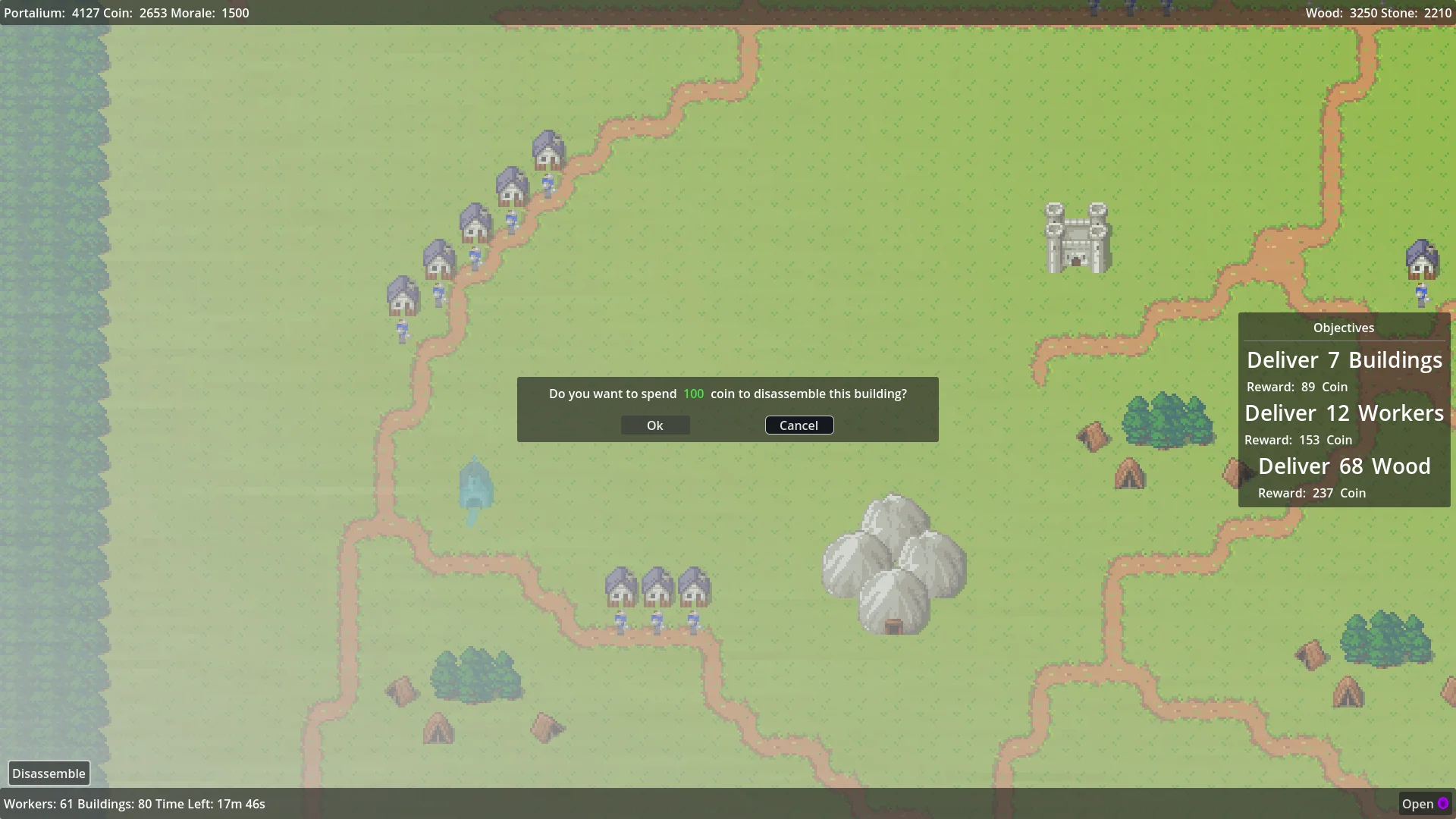
Q: I have gold but the Disassemble button will not work. A: Click the building first to select it, then look for the Disassemble button in the bottom-left corner. The button shows a coin cost. Different buildings cost different amounts to disassemble.
Q: Can I pause during the mist? A: Yes. Escape pauses the game completely, including the mist advance. Use pause freely to assess the situation, plan your moves, and check objectives.
Q: What carries over between cycles? A: Resources stockpiled near the portal (placed by workers before evacuation) are delivered when the portal reopens. Disassembled buildings can be rebuilt. Workers survive. The map layout changes each cycle.
Q: Do I need to evacuate every building? A: No. Only the buildings you want to keep for the next cycle. If a building is low-value (decorative, extra houses), you can let the mist consume it — but each loss costs morale.
Q: Is there a victory condition? A: Not in the traditional sense. The game cycles indefinitely with increasing difficulty. "Winning" means surviving as many settlement cycles as possible before the mist finally overwhelms you.
Q: The game has no sound? A: Correct. Version 0.1.0 is a game jam entry without audio. The developer has indicated potential future updates but has no timeline.
Developer Background & Design Philosophy
Ruins of Enreggel was created by speratus (Andrew Luchuk), a solo developer who asked a simple question: what would a strategy game look like if instead of building a base from the ground up, players started with a completed base and had to disassemble it building by building? The idea emerged during development for the Redot Spring Game Jam 2026, where the theme aligned with this concept.
The developer built the game using Redot, a Godot engine fork, targeting a web build that runs entirely in the browser with zero dependencies. Although the two-week jam deadline was too tight to submit on time, speratus completed the game jam version anyway and published it on itch.io as a free playable experience.
The game's lore — the fallen kingdom of Enreggel, the Grim mist, the nomadic settlements fleeing through dimensional portals — was built to justify the mechanics. The idea of a kingdom that survives by constantly disassembling and fleeing creates a narrative framework where the gameplay loop makes sense. Every evacuation is a tactical retreat, not a defeat.
Speratus has 47 repositories on GitHub covering a range of tools and experiments, but Ruins of Enreggel is their most visible game project. As a game jam entry, the game represents a focused two-week burst of design and implementation, and it shows in the tightness of the core loop.
Comparison With Similar Games
| Game | Ruins of Enreggel | Frostpunk | Banished | This War of Mine |
|---|---|---|---|---|
| Core loop | Disassemble and flee | Build and survive | Build and manage | Scavenge and survive |
| Resource focus | 4 resources + gold | Coal, wood, food, steel | Food, wood, stone, iron | Food, materials, meds |
| Time pressure | Grim mist (explicit) | Temperature (explicit) | Seasonal (implicit) | Day/night cycle |
| Play session | 15-30 min per cycle | 2-4 hours per scenario | Unlimited | 1-3 hours per playthrough |
| Difficulty | Medium | Hard | Medium | Hard |
| Unique mechanic | Reverse city-building | Generator heat | Self-sustaining economy | Moral decisions |
Ruins of Enreggel sits in a unique niche: it is the only game where the goal is to tear down rather than build up. This makes it a refreshing palate cleanser for anyone tired of the standard city-builder formula.
Changelog & Version Notes
| Version | Date | Notes |
|---|---|---|
| 0.1.0 | June 2026 | Initial game jam release. Base disassembly mechanics, four resource types, portal evacuation system, King's objectives, Grim mist progression. No sound. Known bugs and balance issues expected. |
Guide last updated July 2026. Game How To editorial team verified all mechanics against the live browser version 0.1.0.
Screenshots