Official game
Play Thousand Floors
This game is hosted by Steam. Continue to the official page to play or download it.
Buy on SteamOverview
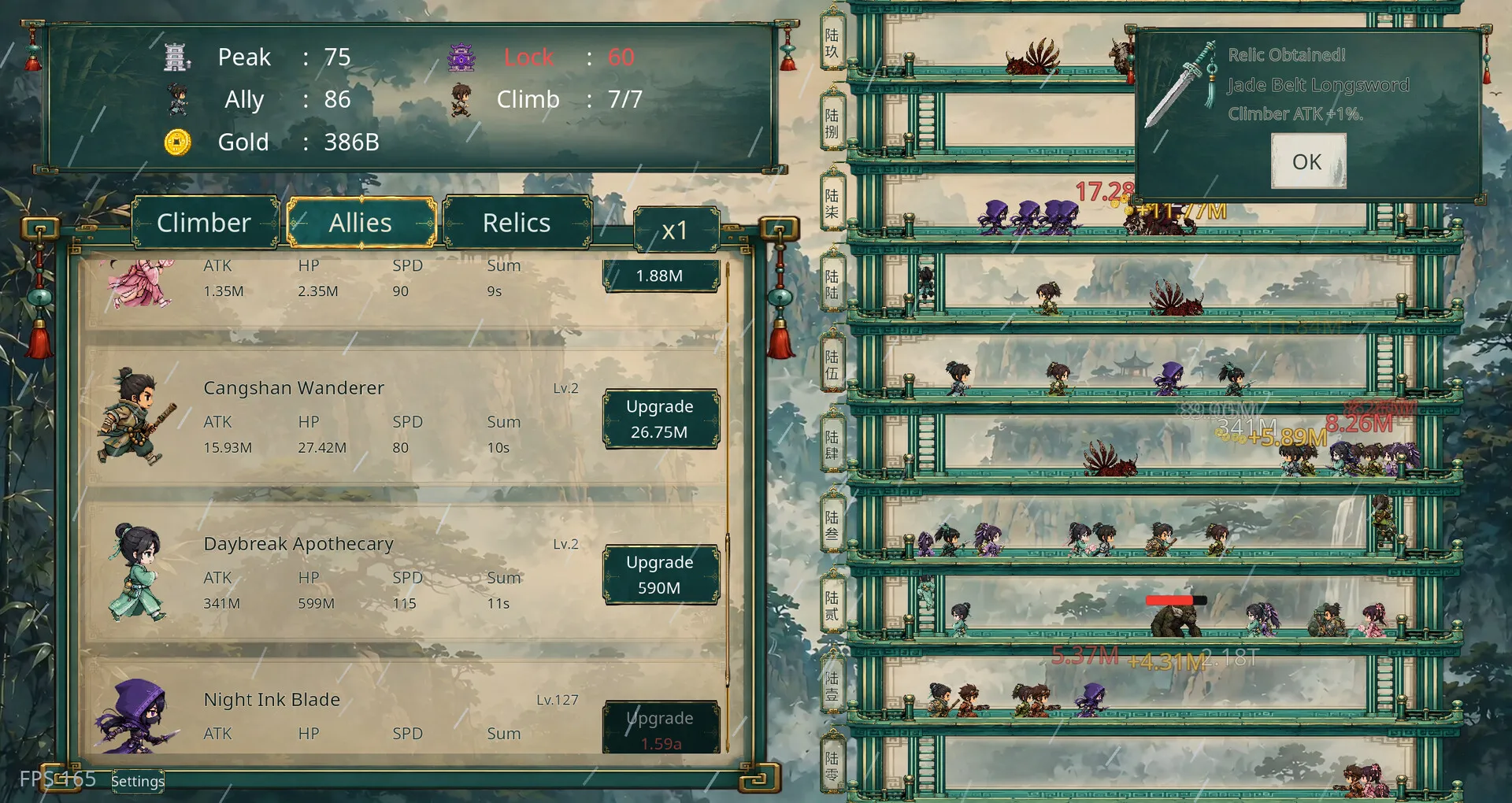
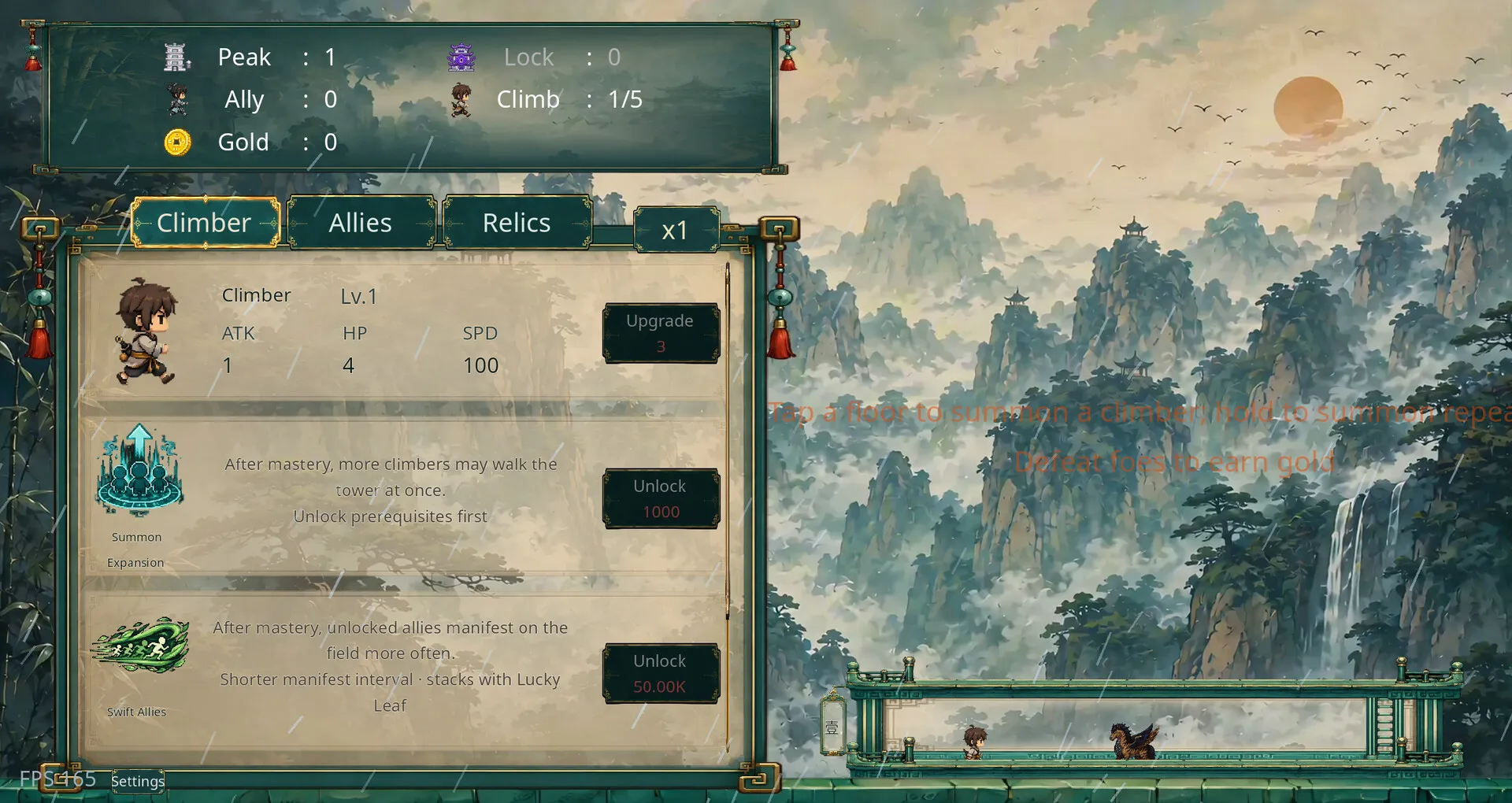
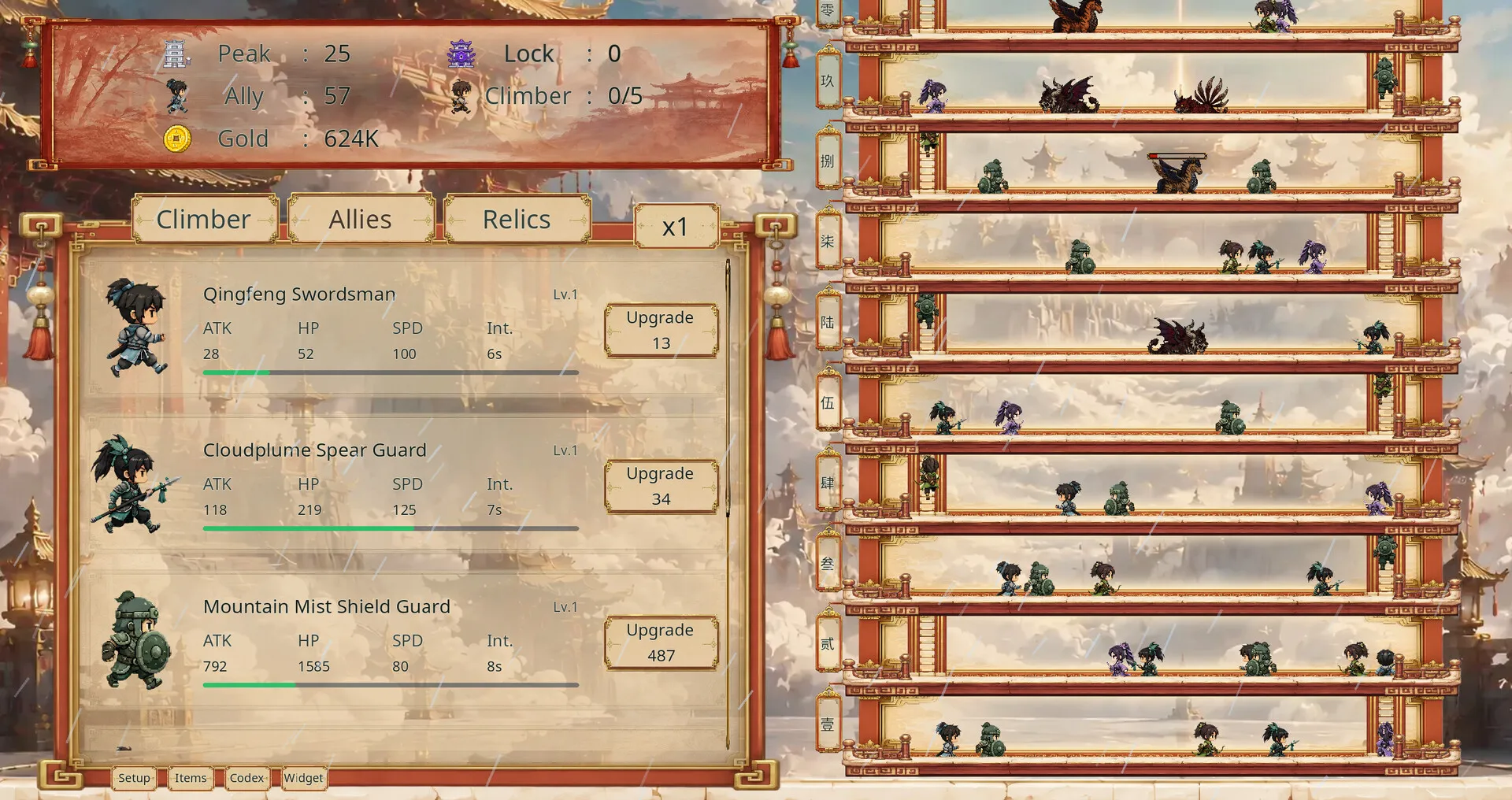
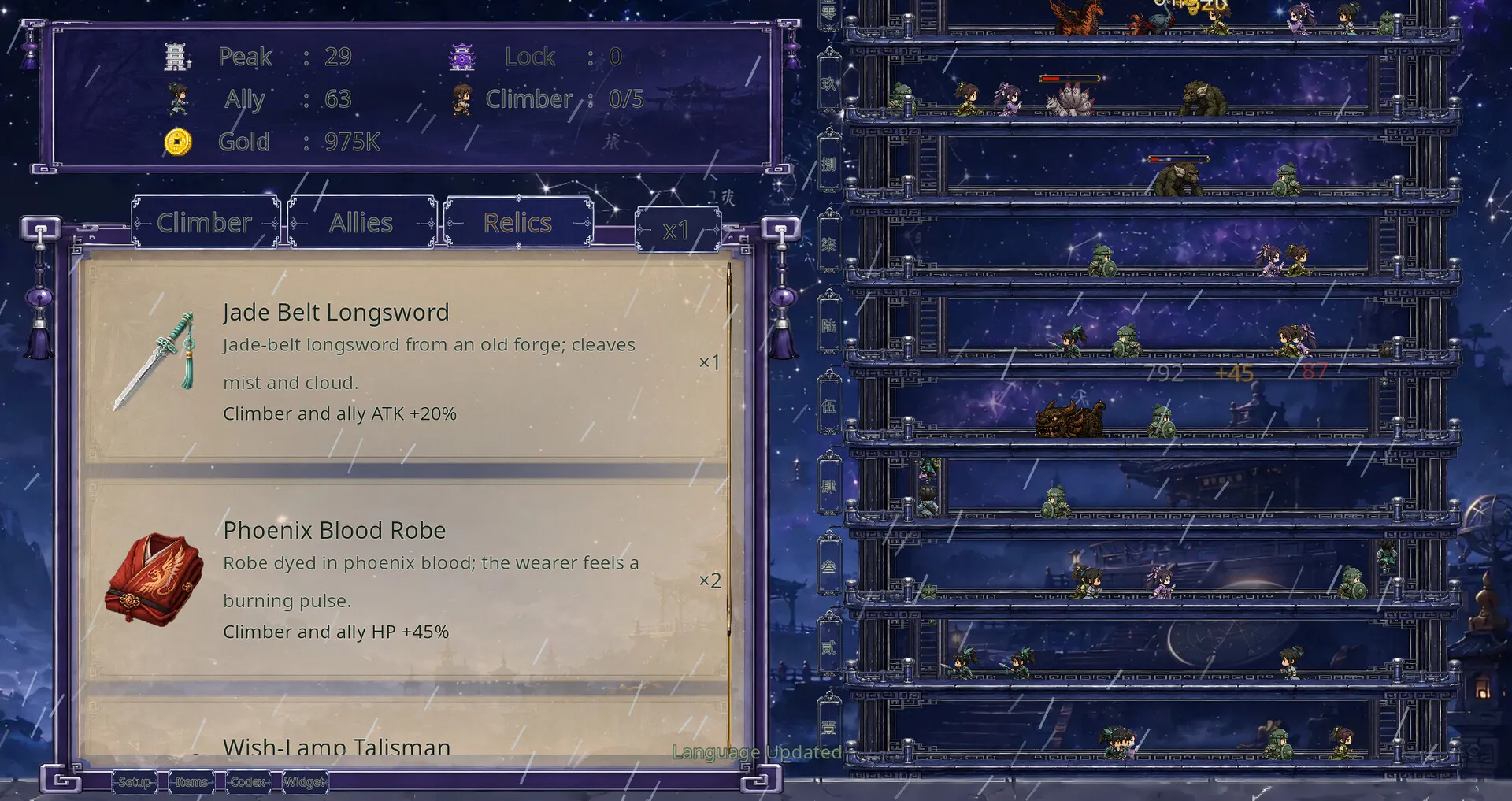
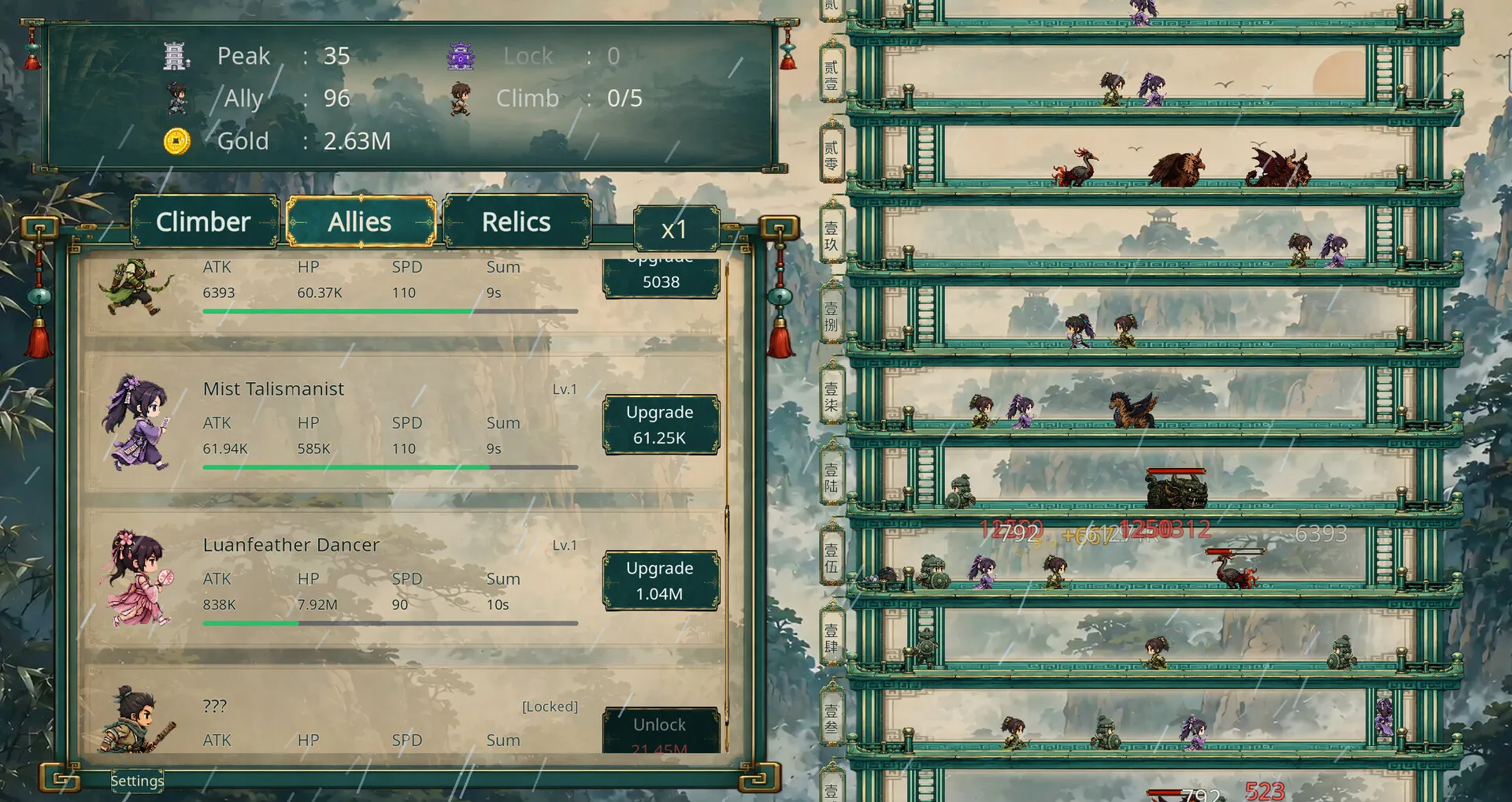
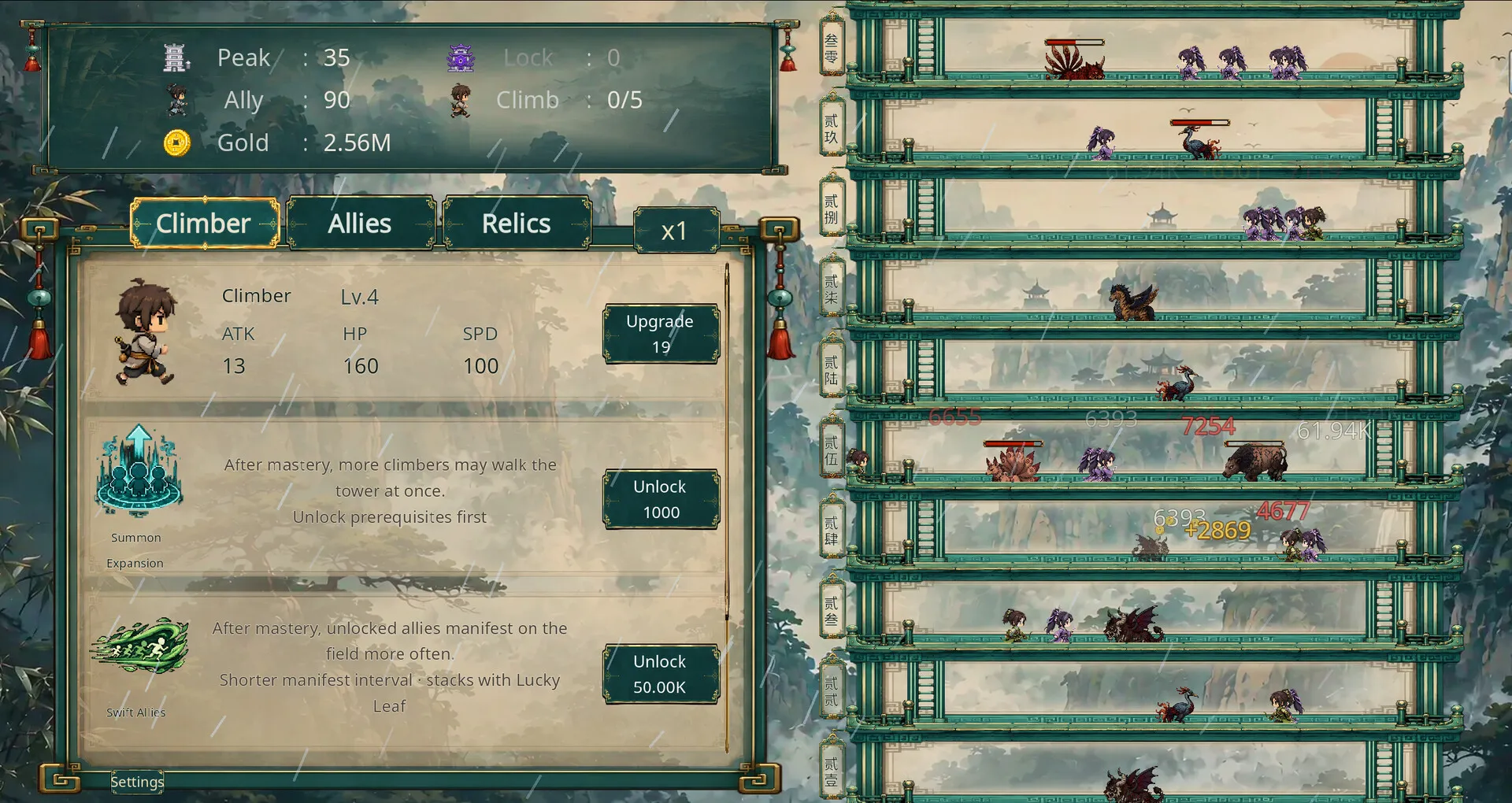
Thousand Floors is a Chinese-inspired pixel-art idle tower-climber from Amber Tower Studio (琥珀塔). You summon Tower Climbers and allied units that auto-battle through an endless pagoda, fighting creatures from the Classic of Mountains and Seas. The game blends idle progression with active tactical decisions — where you tap, when you Lockdown, which allies you deploy, and when you Rebirth.
Released June 18, 2026 on Steam for S$11.25 (~US$8.43). The tower extends past floor 10,000 with gradual difficulty scaling. 206 Steam recommendations at launch. 17 achievements. Steam Cloud saves, Leaderboards, and a player-driven Marketplace.
The game runs on any potato — Intel HD 4000 graphics, 2 GB RAM, 500 MB storage. Mouse-only mode available. No timed inputs. Save anytime.
Getting Started
Thousand Floors is a resource-management roguelike: you climb floors, juggle three resources (gold, crystals, and time), and make permanent choices that shape every future run. Your first runs are about learning the resource economy, not reaching high floors.
First-session priorities:
- Learn the three-resource loop. Gold buys immediate power, crystals buy permanent meta-progression, and time is the constraint that forces trade-offs. The "Three Resources" section below breaks down the full economy.
- Don't hoard gold. Gold is a per-run resource — spend it on upgrades before you climb, because you lose it at the floor reset.
- Read the Floor Lockdown System early. Knowing when to lock a floor's bonuses versus pushing onward is the single biggest decision in the game.
- Expect to restart. Early runs teach the systems; your first deep climb comes after a few deaths. That's the intended curve.
Who This Guide Is For
This guide assumes you've played the first hour. It covers the math behind the mechanics, optimization strategies, and the decision framework that separates a floor-1000 climber from a floor-100 tapper.
The Three Resources — Gold, Crystals, and Time
Thousand Floors has three currencies, and each one behaves differently:
Gold
- Drops from kills, chests, offline income
- Spent on Mystic Arts and ally training
- Rule: Spend it immediately. Gold not spent is gold wasted — every upgrade increases your income rate, which pays for the next upgrade faster. The only exception is saving for a high-cost node you're one floor away from unlocking.
Rare Crystals (Bottleneck Resource)
- Drops from milestone chests and rare enemy kills
- Spent on high-tier Mystic Arts nodes and ally unlocks
- Rule: These are your actual strategic resource. Never spend crystals on something you'll replace in 10 floors. Prioritize permanent improvements — Summon Capacity upgrades (they never become obsolete) and Lockdown capacity. Avoid spending crystals on temporary combat stat boosts.
Time (The Hidden Resource)
- Offline gold accumulation is a flat rate, not your peak rate
- Active play yields ~3-5x more gold per minute than idle
- The game rewards checking in every few hours to collect, spend, and push
The Floor Lockdown System — Complete Optimization
Lockdown is the single most important mechanic in the game. Most players who stall under floor 200 are not using it correctly.
Lockdown Modes
| Mode | Configuration | Effect | When to Use |
|---|---|---|---|
| Push Mode | Lock all floors below current max | All climbers spawn at your highest floor | Breaking through a hard floor, boss fights |
| Farm Mode | Lock nothing | Climbers spread across all unlocked floors | Gold farming, offline accumulation |
| Focus Mode | Lock all but 2-3 floors | Balanced between push power and farm income | General progression, mid-game |
| Boss Rush | Lock everything 3 floors before boss | Every new climber joins boss fight immediately | Boss floor (every 10th floor) |
The Lockdown Rotation (Expert Technique)
The optimal cadence is not static. It changes with your progression stage:
Early game (floors 1-200): Use Push Mode exclusively. The gold difference between floor 50 and floor 100 is so large that any spread of climbers to lower floors is wasted. Unlock Lockdown capacity as your top Mystic Arts priority.
Mid game (floors 200-1000): Switch to the Push-Farm Rotation. Push 10-15 floors in Push Mode, then switch to Farm Mode for 5 minutes of offline accumulation. The ratio should be roughly 2:1 push-to-farm. This yields ~40% more total gold than either mode alone.
Late game (floors 1000+): Focus Mode becomes optimal. Lock everything below your second-highest unlocked floor. This keeps roughly 80% of your climbers on the push floor while the remaining 20% farm the next floor down for gold and chests.
Ally Tier List and Composition Guide
Tier List (v1.0.26)
| Tier | Ally | Role | Notes |
|---|---|---|---|
| S | Spear Guard | Frontline tank | Push resistance is invaluable for stabilizing your front line. Every composition needs one. |
| S | Apothecary | Party regen | The only source of sustained party healing. Without this, your climbers melt to prolonged fights. |
| A | Dancer | Attack speed buffer | Attack speed multiplies all other stats. The Dancer's buff affects every unit on screen. |
| A | Archer | Ranged DPS | Attacks from behind melee line, avoids collision damage. Essential against heavy melee floors. |
| A | Shield Bearer | HP tank | Higher raw HP than Spear Guard. Better against bosses, worse against swarms. |
| B | Talismanist | Magic damage | Good against armor-type enemies. Situational. |
| B | Wandering Monk | Single-target heal | Apothecary's regen is better in most scenarios. Monk only for boss-heavy floors. |
| B | Artificer | Gold find | When you're actively farming gold, swap this in. Never use for pushing. |
| C | Assassin | Single-target burst | High burst but long cooldown. Underwhelming against swarms. Only for boss floors. |
| C | Sword Cultivator | Melee DPS | The starting ally. Replaced by better options within the first hour. |
Optimal Compositions by Floor Type
| Floor Type | Composition |
|---|---|
| Beast floors (fast melee) | 1 Spear Guard + 2 Archers + 1 Apothecary + 1 Dancer |
| Spirit floors (magic) | 1 Shield Bearer + 2 Talismanists + 1 Apothecary + 1 Wandering Monk |
| Construct floors (high HP) | 1 Spear Guard + 1 Shield Bearer + 2 Archers + 1 Assassin |
| Draconic/boss floors | 2 Spear Guards + 1 Shield Bearer + 1 Apothecary + 1 Dancer |
| Farming (any floor type) | 1 Spear Guard + 1 Artificer + 1 Archer + 1 Apothecary + flex |
Mystic Arts — Optimal Upgrade Order
The Mystic Arts tree resets on Rebirth, so the order you buy nodes in each run is critical.
First Run Priority
- Foundation → Summon Capacity (level 3) — More climbers on screen = more damage output. This is your single biggest power spike.
- Lockdown (level 2) — Being able to seal 2 floors is enough to start Push Mode effectively.
- Combat Training → Attack (level 3) — Flat damage increase helps every unit.
- Essence → Gold per Kill (level 2) — More gold = faster upgrades. This snowballs hard.
- Active Arts → Renewal — One active heal can save a boss push from failing.
- Combat Training → HP (level 2) — Survivability for your frontline.
- Lockdown (level 3+) — More sealable floors = more control.
- Foundation → Spawn Rate (level 2) — Climbers return faster after dying.
Second Run and Beyond Priority
The order shifts once you have Relics providing stat bonuses:
- Lockdown (max as fast as possible)
- Foundation → Summon Capacity (max)
- Essence → Gold per Kill (max)
- Active Arts → Renewal + War Cry
- Foundation → Active Art slots
- Everything else
What to Skip (At Least for First 10 Runs)
- Training → Move Speed. Move speed is nice but not impactful until late game when your frontline needs to reach enemies faster. Not worth the crystal cost early.
- Essence → Offline Income. Offline income scales with your active rate. Investing in active gold per kill first makes offline income naturally higher.
- Active Arts → Cloud-Step. Experienced players can use this to skip floors. For most players, the floor-skip ability is confusing and often wastes more time than it saves.
Advanced Tips
When to Rebirth
The rule of thumb: Rebirth when your climb speed drops below 1 floor per 30 seconds of active play.
Concrete triggers:
- First run: Rebirth at floor 50-80 (or when you first stall hard).
- Runs 2-5: Every 100-150 floors.
- Runs 6-15: Every 200-300 floors.
- Runs 15+: Every 500+ floors.
Pre-Rebirth Checklist
Before clicking Rebirth:
- Push for a personal record. Even 10 more floors increases your Wish-Lamp roll quality.
- Collect all milestone chests you can reach. Those Relics are permanent.
- Spend all gold. Any unspent gold is lost on Rebirth. Buy every affordable Mystic Arts node.
- Check your Relic Codex. If you're close to a codex milestone (e.g., 2 more unique Relics), push for it before Rebirth.
- Roll the Wish-Lamp. The Talisman charges scale with your max floor reached. Roll for: "Bonus Gold Find" (if your gold income is the bottleneck) or "Reduced Enemy HP" (if your damage is the bottleneck). Avoid rolling for bonuses you already have from Relics (check your Codex first).
Wish-Lamp Target Priority
| Wish Bonus | Value | When to Pick |
|---|---|---|
| Bonus Gold Find | Very High | First 5 runs, or if Relic Codex already has strong damage bonuses |
| Reduced Enemy HP | High | Mid-game when damage feels low despite good gold income |
| Faster Ally Spawn | Medium | Late-game when you have most ally types unlocked |
| Bonus Chest Odds | Medium | Always decent, never amazing |
| Extra Artifact Drops | Low | Artifacts are not impactful enough to prioritize |
Advanced Tactics
The 3-Floor Boss Warning Exploit
When the game announces a boss 3 floors ahead, immediately:
- Switch Lockdown to Boss Rush mode (lock everything below your current floor).
- Swap allies to boss composition (2 Spear Guards + Shield Bearer + Apothecary + Dancer).
- Queue Renewal (don't activate until boss fight starts).
- Start tapping early — fill your summon cap before the boss floor loads.
This pre-loading tactic can double your effective DPS on the boss floor.
The Mid-Run Relic Check
Every 50 floors, check your Relic Codex progress. If you're close to unlocking a new Relic (e.g., 8/10 for the next tier), focus on milestone chests instead of pure floor pushing. A single new Relic bonus often provides more power than 20 floors of Mystic Arts upgrades.
Active Art Sequencing (Burst Windows)
For maximum burst damage (e.g., breaking through a hard wall):
- War Cry (damage buff) → wait 1 second
- Gale (speed buff) — now your climbers crash in with both buffs
- When frontline hits 50% HP → Renewal (full heal)
- Cloud-Step (only if boss is at <10% HP and about to kill you)
This sequence clears ~20-30 floors in under a minute when executed correctly.
The Widget Mode Advantage
Thousand Floors has a widget mode that shrinks the game to a compact window. Use this for passive progression while doing other work. The widget shows your front line and lets you tap without switching to fullscreen. This is the most efficient way to accumulate gold over long sessions without burning out.
The Steam Marketplace
The Marketplace is controversial among early adopters. Here's the practical take:
- You can ignore it completely. All content is unlockable through normal gameplay.
- If you participate: sell surplus materials and training scrolls. Buy scarce items you need.
- Prices are volatile at launch. Don't invest heavily until the economy stabilizes.
- The Marketplace uses in-game currency, not real money. No pay-to-win concerns.
FAQ
Q: How active do I need to be? A: The game runs offline, but active play is ~3-5x more efficient. Check in every 2-3 hours to spend gold and push floors.
Q: What's the fastest way to progress? A: Master the Lockdown Rotation (Push-Farm cycle), spend gold immediately, and Rebirth at the right time. These three habits matter more than any single upgrade.
Q: Are there microtransactions? A: No. The Marketplace uses in-game currency only.
Q: How long does it take to reach floor 1000? A: With optimal play, roughly 15-20 hours. Casual play ~30-40 hours.
Q: What carries over through Rebirths? A: Relics (permanent stat bonuses), ally unlocks and training levels, Steam achievements. Mystic Arts and floor progress reset.
Q: Is the game worth the $8.43 price point? A: For incremental/idle game fans, yes — 50-100+ hours of content. For casual players who want a polished experience, wait for more updates.
Q: Will there be more content updates? A: The developer has released multiple hotfixes within days of launch, indicating active post-launch support. A content roadmap hasn't been announced.
Screenshots