Official game
Play Precinct IX
This game is hosted by Steam. Continue to the official page to play or download it.
Wishlist on SteamOverview
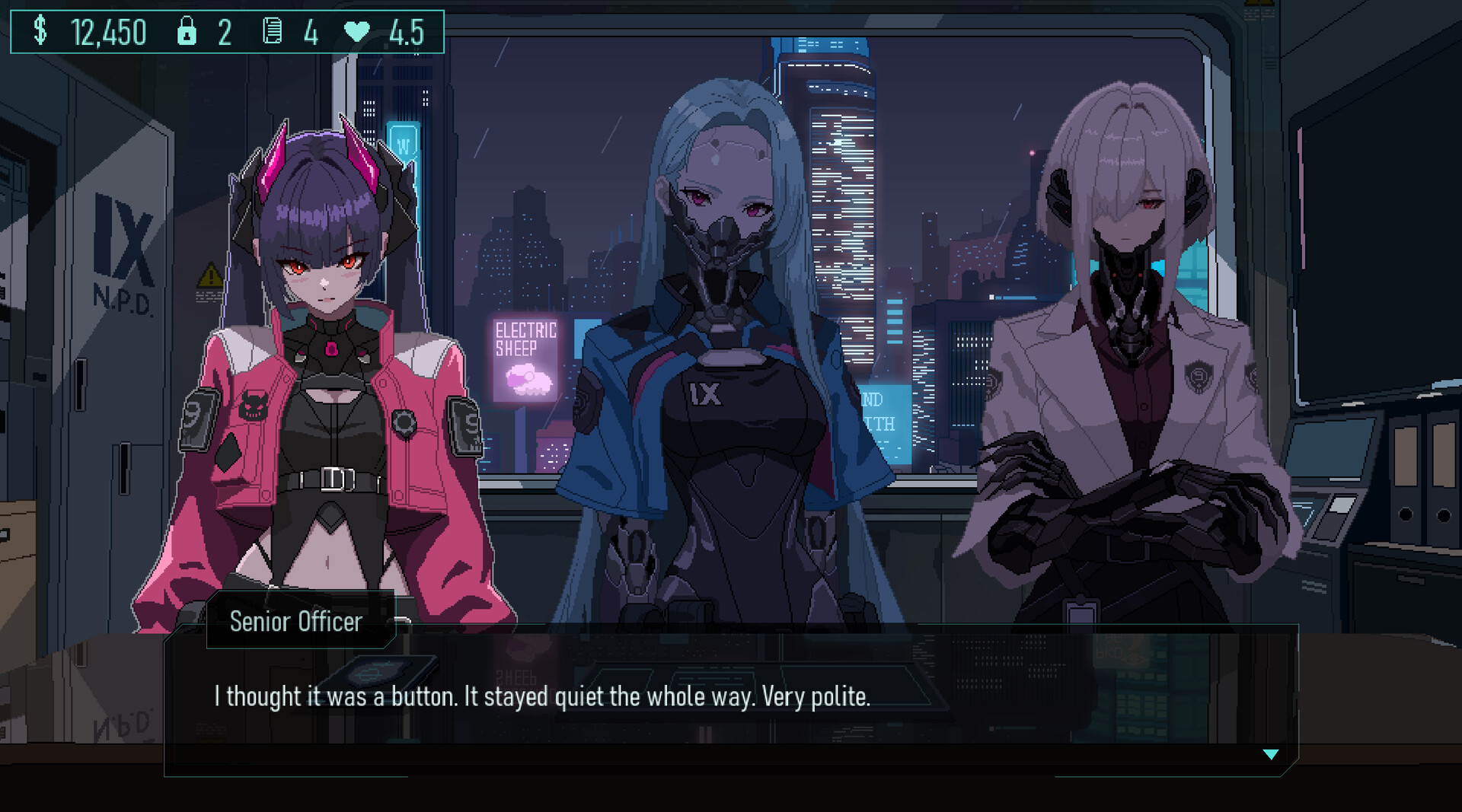
Precinct IX is a cyberpunk police management and turn-based combat game from indie studio ZataForge, planned for release in 2026 on Windows, macOS, and Linux. You are the commanding officer of Precinct IX, a broke, understaffed police station in a future city where cybernetics are common and unstable. Your officers are all cybernetically augmented women, each carrying abilities, a personal history, and secrets she will not easily volunteer. As trust deepens, their personal stories open up, and the rotten truth beneath the city starts to surface.
The game is a deliberate hybrid: precinct management sim, visual novel with branching character storylines, turn-based tactical combat, and relationship building in the tradition of Persona's social link system. The developer calls this a five-layer design, and all five layers feed into each other. Management decisions determine which officers are available. Dispatch choices determine which cases resolve. Case outcomes determine the relationships that unlock character stories.
Who it's for: Fans of XCOM-style base management, Disco Elysium's moral weight, Persona's social links, and Invisible Inc.'s dispatch tension. Anyone who wanted This Is the Police with more depth and more neon.
Who it's not for: Players who want a single-genre experience, fast action, or a power fantasy. This is a game about scarcity, pressure, and hard choices. The power curve is about surviving, not dominating.
| Fact | Detail |
|---|---|
| Developer / Publisher | ZataForge Studio |
| Genre | Cyberpunk police management + turn-based tactics + visual novel |
| Platforms | Windows, macOS, Linux |
| Release | 2026 (date TBA) |
| Price | TBA |
| Players | Single-player |
| Playtime | 10–15 hours (estimate) |
| Difficulty | Medium |
| Wishlists | 10,000+ (as of July 2026) |
| Steam Features | Achievements, Steam Cloud, Family Sharing, full controller support |
| Languages | 11 (interface + subtitles) |
| Art | Hand-drawn pixel art, anime-influenced character design |
Mac warning: the Steam listing specifies the game is NOT compatible with macOS 10.15 Catalina or above, limiting it to macOS 10.14 Mojave or earlier. Steam dropped its own client support for macOS 10.14 in February 2024, so the practical compatibility of the macOS build with any currently maintained Mac is in question. Windows and Linux are the safer platforms.
The Five-Layer Design
The core of Precinct IX is five systems that interact rather than sit side by side. Understanding how they chain together is the difference between commanding a precinct and drowning in one.
- Intake. Complainants, informants, black-market dealers, and representatives from institutional power arrive with requests, agendas, and pressures. You decide which cases to accept, negotiate terms, and contend with bribery and conflicting motives from the first screen.
- Resource management. Budget, manpower, weapons, cybernetic components, and medical supplies are finite. Everything must be allocated before officers are ever dispatched.
- Officer selection. Each officer has distinct capabilities that determine fit for a given incident type. The right officer turns a hard case easy; the wrong one turns an easy case fatal.
- Field resolution. Cases close through dialogue choices, field commands, or turn-based tactical combat. Outcomes feed back into the precinct's operational state.
- Relationships. Trust accumulates through every command decision and shared outcome. High trust unlocks individual character storylines, which is where the systemic corruption behind the official cases becomes concrete.
Every decision in layer one spends resources in layer two, which constrains layer three, which determines layer four's outcome, which feeds layer five. Plan across all five at once.
Getting Started: Your First Session
Before You Launch
- Understand the two-layer loop. You play the management layer (office, cases, resources) and the tactical layer (dispatch, turn-based combat). Neither works without the other.
- Read your officers' files. Their abilities, pasts, and secrets are both content and mechanical advantage. A file read now saves a lost officer later.
- Expect scarcity. You will not have enough of anything. Budgeting is the game.
Your First 30 Minutes
- Receive your first visitors. Complainants, informants, and black-market dealers step into your office. Accept cases, negotiate terms, allocate resources.
- Build your case board. Each case has threads: witnesses to interview, scenes to visit, suspects to interrogate.
- Dispatch carefully. Choose the right officer for each case based on abilities and condition. A wounded officer is a liability, not a hero.
- Run your first encounter. Position, abilities, and target priority decide outcomes.
- Watch the budget. Equipment, loadouts, and medical support drain it fast. Prioritize cases that pay.
Beginner Mistakes
| Mistake | Why It Hurts | Fix |
|---|---|---|
| Sending wounded officers out | They underperform and risk permanent loss | Rotate officers; keep a rested reserve |
| Accepting every case | Overcommitting bankrupts the precinct | Prioritize by payout and threat |
| Ignoring officer stories | Their secrets unlock abilities and alter outcomes | Talk to officers between cases |
| Buying gear before meds | Gear is useless on corpses | Fund medical support first |
| Treating battles as isolated | Field outcomes feed back into precinct resources | Plan battles as part of the case |
| Skipping interrogation options | Cases crack through information, not force | Exhaust every dialogue option |
Core Mechanics Explained
The Resource Triangle
Three resources anchor everything: budget, manpower, and medical support. Weapons and cybernetic parts sit on top of them.
| Resource | What it does | How to manage it |
|---|---|---|
| Budget | Funds equipment, upgrades, medical support | Prioritize cases that pay; avoid waste |
| Manpower | Number of deployable officers | Rotate; keep a reserve |
| Weapons | Combat effectiveness | Upgrade for high-threat cases |
| Cybernetic parts | Officer upgrades and repairs | Ration; don't over-upgrade one officer |
| Medical support | Keeps officers alive and fighting | Fund first; it protects everything else |
Case Types and Threats
The city throws recurring incident types at you: runaway cybernetics, memory contamination, hacker attacks, abnormal sightings, and street riots. Each demands a different officer profile. A hacker case wants a technical specialist; a riot wants raw combat power; an abnormal sighting wants an investigator with high perception. Match the officer to the incident type or accept the consequences.
The Investigation Layer
Cases unfold through investigation: interview witnesses, visit crime scenes, gather evidence, interrogate suspects. Every lead costs time and manpower. Investigation is a resource-intensive process, not a free exploration mode. Case outcomes change through dialogue, command, and battle.
Turn-Based Combat
Combat is the tactical payoff. You command your dispatched officers in turn-based encounters against runaway cybernetics, hackers, rioters, and worse. Positioning, ability use, and target priority matter. A botched operation drains supplies and damages officer morale. A clean resolution builds trust and opens access to what an officer has been quietly carrying.
The Trust System
Trust is the currency that opens officer stories. It accumulates through every command decision and shared outcome: choosing the right officer for a case, keeping them alive, making choices they respect. Officers with high trust fight better, reveal more during interrogation, and unlock narrative choices. The stories they open are where the game's promised "rotten truth beneath the city" becomes specific rather than atmospheric.
Progression Strategy
The Case Priority Framework
Not all cases are equal. Grade every case before accepting:
| Factor | Weight | Why |
|---|---|---|
| Payout | High | Funds everything else |
| Threat level | High | A botched high-threat case costs more than a case's worth of resources |
| Officer fit | High | Right officer = efficient resolution |
| Story flags | Medium | Cases connected to officer arcs advance the trust system |
| Time sensitivity | Medium | Some cases degrade if ignored |
The Medical-First Budget
Fund medical support before weapons. A dead officer is a permanent loss of ability, story, and trust. Gear can be replaced; officers cannot. Medical support protects your most expensive asset, so it always wins the budget argument in the early game.
The Two-Team Rotation
Never field your best officers for every case. Build two balanced teams and rotate them: one team works a case while the other recovers. This keeps officers fresh, spreads experience, and guarantees a rested reserve for emergencies.
Early-Game Spending Order
- Medical support (keeps the roster alive)
- One loadout upgrade per frontliner (combat viability)
- Cybernetic maintenance for your most-used officer (efficiency)
- Case board expansion (more active threads)
- Weapon upgrades (only after the above)
Builds / Tier Lists / Best-In-Slot
Officer Archetype Tier List
Officer rosters in the genre settle into recognizable archetypes. Precinct IX's confirmed structure (abilities, personal history, secrets) maps onto these roles:
| Tier | Archetype | Strengths | Best Use |
|---|---|---|---|
| S | Technical Specialist | Hacker attacks, cybernetic incidents, memory contamination | The cases that quietly end precincts |
| S | Investigator | Perception, interrogation, abnormal sightings | Cracks cases through information |
| A | Frontline Combatant | Riots, high-threat field battles | The muscle for when dialogue fails |
| A | Negotiator | Intake, bribery, witness interviews | Saves resources before combat starts |
| B | Generalist | Balanced, flexible | Rotation filler, backup duty |
Best-in-slot logic: build a specialist for each recurring incident type, then keep one generalist as your emergency dispatch. A specialist on their home case type outperforms a generalist everywhere; a generalist never fails you on an unknown case.
Budget Allocation Template
| Phase | Budget Split | Rationale |
|---|---|---|
| Early game | 40% medical, 30% loadouts, 20% cybernetic parts, 10% case board | Keep officers alive and combat-viable |
| Mid game | 30% medical, 25% weapons, 25% cybernetic upgrades, 20% expansion | Threat levels rise; upgrade the front line |
| Late game | 25% medical, 30% weapons, 30% story investment, 15% reserve | Officer stories drive the endgame |
Step-by-Step Strategy
Sequence 1: The Intake Protocol
- Let the visitor speak before you commit to anything. The first version of a story is rarely complete.
- Grade the case: payout, threat, officer fit, story flags, time sensitivity.
- Negotiate terms. Some cases come with strings attached; decide whether the string is worth the payout.
- Read the subtext. Hidden motives mean the obvious choice is often wrong.
- Accept or decline with full knowledge of what it costs your other cases.
Sequence 2: The Dispatch Decision
- Open the case file and identify the incident type.
- Match the officer archetype to the incident: specialist for their home type, generalist for unknowns.
- Check officer condition. Wounded officers stay home, no exceptions.
- Check trust level. A high-trust officer resolves faster and reveals more.
- Allocate supplies for the operation, then commit.
Sequence 3: The Interrogation Exhaustion Rule
- Never end an interrogation with dialogue options unread.
- Work through every branch: hidden motives, secret connections, and case-altering revelations surface in the last options.
- Use officer specialties during interrogation. An Investigator extracts more than a Combatant.
- Track what each suspect contradicts. Contradictions are case leads.
- Close the interrogation only when the tree is empty.
Sequence 4: The Turn-Based Combat Checklist
- Survey the field before moving anyone.
- Position for cover and sightlines; the city fights back.
- Prioritize targets: medics and summoners first, then the biggest threat to your lowest-HP officer.
- Use abilities on cooldown that matters, not on cooldown that exists.
- Retreat a wounded officer before the mission ends; a live retreat beats a dead win.
Sequence 5: The Relationship Investment Loop
- Talk to officers between cases, every time.
- Choose command decisions that match their values; trust is earned through respect, not efficiency.
- Prioritize cases tied to officer storylines once your roster is stable.
- Keep the story-relevant officer alive above all else; their arc is the game's spine.
- Let the trust you build open the corruption storyline that ties the cases together.
Advanced Tips
The botched-op math. A botched operation drains supplies AND damages morale. Two failed operations can cost more than the case was ever worth. If a case looks unwinnable with your current roster, decline it. Declining is a valid strategic move.
The bribery play. Not every visitor is honest and not every case is clean. Sometimes taking the black-market deal is the strategic play; sometimes refusing it is. The "obvious" choice in a negotiation is usually the trap. Read the subtext.
The story investment is the best mechanical investment. Officers with high trust improve every case they touch: faster resolutions, better interrogation results, stronger combat performance. Investing in their personal stories is not content tourism; it is the most efficient stat boost in the game.
The reserve rule. Always keep at least one officer off the board. Emergencies do not schedule themselves, and an uncommitted officer is the difference between handling a sudden riot and watching it burn a week of progress.
Scarcity is the design. The game wants you to feel the weight of commanding people, not just tokens on a grid. When you feel the pinch, that is the game working. Spend like a broke precinct commander, because you are one.
Case threads compound. Witnesses, scenes, and suspects connect across cases. A lead ignored in one case often reappears in another. Keep notes on who said what; the game rewards institutional memory.
FAQ / Common Mistakes
Q: Is Precinct IX a combat game or a management game? A: Both, simultaneously. The management layer (office, cases, resources, officers) and the tactical layer (dispatch, turn-based combat) are interconnected. Neither works without the other.
Q: When does it release? A: Planned for 2026 on Steam, no specific date or price announced yet. The game passed 10,000 wishlists in July 2026, announced in character by the developer as one of the precinct's officers.
Q: Is there a demo? A: Not yet. The developer's "city gates aren't open yet" framing suggests one arrives closer to launch.
Q: Do officers die permanently? A: The game emphasizes limited medical support and officer condition. The scarcity framing and "no one can promise you'll come back from a call in one piece" tone strongly suggest officers can be lost. Treat every officer as irreplaceable.
Q: Will it run on my laptop? A: Minimum specs are very modest: dual-core CPU, 2 GB RAM, integrated GPU, 2 GB storage. Recommended is a dedicated GPU and 4 GB RAM with 10 GB storage. The pixel-art style keeps the footprint small. Mac users: check your macOS version carefully (see the warning in Overview).
Q: Is there controller support? A: Yes, full controller support is confirmed, alongside Steam Achievements, Cloud saves, and Family Sharing.
| Mistake | Why It Hurts | Fix |
|---|---|---|
| Accepting every case | Resources are finite; overcommitment bankrupts you | Grade cases by payout, threat, and officer fit |
| Sending wounded officers | Underperformance and permanent loss risk | Rotate; keep a rested reserve |
| Buying gear before meds | Gear is useless on dead officers | Fund medical support first |
| Ending interrogations early | The last dialogue options carry the case-cracking info | Exhaust every branch |
| Ignoring officer stories | Missed abilities and altered outcomes | Invest in trust between cases |
| Treating combat as isolated | Losses drain precinct supplies and morale | Plan battles as part of the case economy |
| Hoarding budget | Stalled progression; upgrades pay for themselves | Spend on medical, then loadouts, then weapons |
Final Verdict
Precinct IX is one of the more ambitious indie pitches in Steam's 2026 catalog: five interconnected systems running XCOM-style management, Persona-style relationships, and Disco Elysium-style moral weight in parallel. The all-female officer roster is a deliberate design choice that shapes the trust system, and the five-layer architecture gives every decision compounding consequences. The macOS compatibility caveat is a real concern for Mac players, and the lack of a demo means the integration quality is unproven until launch. But the architecture is coherent, the individual layers are proven genre templates, and the 10,000+ wishlist milestone shows real demand. For fans of management tactics with narrative teeth, this is the one to watch in 2026.