Daily Pick
One deeply researched guide worth reading today.
A practical route through the systems that matter most, written to help new players make confident decisions quickly.
Overview: What Kind of Game Is Slayblade?
Slayblade is a run-based battle-tops roguelite from Henry's House, the studio behind Nanomon Virtual Pet, Kardboard Kings, and Desert Child. You build a battle-top ("blade"), fight street battles for cash, spend winnings on new parts, and merge their powers to dominate a miniature PS1-inspired Y2K city. It releases on Steam August 20, 2026.
The core pitch: Beyblade-style top battles with a chill roguelite loop. Each run you collect parts, win money, and push further up the street-battle ladder. The official description jokes "if you Die in the game, you Die in real life"; the actual tone is playful, lo-fi, and snackable. The whole game runs on a mouse and left-click.
What separates Slayblade from a toy-simulator is the merge system. Parts do not just stack stats; they combine powers, and finding insane combos is the stated endgame. The 60+ part collection, the run structure, and the Y2K setting (hand-drawn character art, street-corner battles, a miniature city to skate around) give it the "chill roguelite" feel the Steam page advertises.
Who is this for? Players who enjoyed Beyblade as kids, roguelite deck-builders that reward combo discovery, or Oscar Brittain's earlier games (Kardboard Kings' shop-management loop, Desert Child's hoverbike races, Nanomon's pet-raising). If you want a deep story mode or multiplayer competition, Slayblade explicitly does not have those; the game is built around short, satisfying battle loops and customization.
| Field | Detail |
|---|---|
| Genre | Action roguelite / battle-tops |
| Developer | Henry's House, Oscar Brittain |
| Publisher | Henry's House |
| Platform | Windows (Steam) only |
| Price | TBA |
| Players | Single-player |
| Release | August 20, 2026 |
| Input | Mouse only (left-click); partial controller support |
| Parts | 60+ collectible blade parts |
| Demo | Free on Steam (app 4682290), "Very Positive" (162/26) |
| Steam | store.steampowered.com/app/4117730 |
| Website | henryshouse.com.au |
The Battle-Tops Loop
Slayblade's loop is three beats repeated across every run:
- Battle. Fight street battles with your blade. The controls are simple and satisfying by design; the Steam page promises "SUPREMELY SATISFYING controls" with the whole game playable via mouse and left-click.
- Spend. Take the cash you won and buy NEW parts.
- Merge. Find insane combos with the parts you unlock.
The run structure makes each session self-contained: collect parts, win cash, upgrade, push further. Death ends the run and sends you back with whatever progression the roguelite keeps.
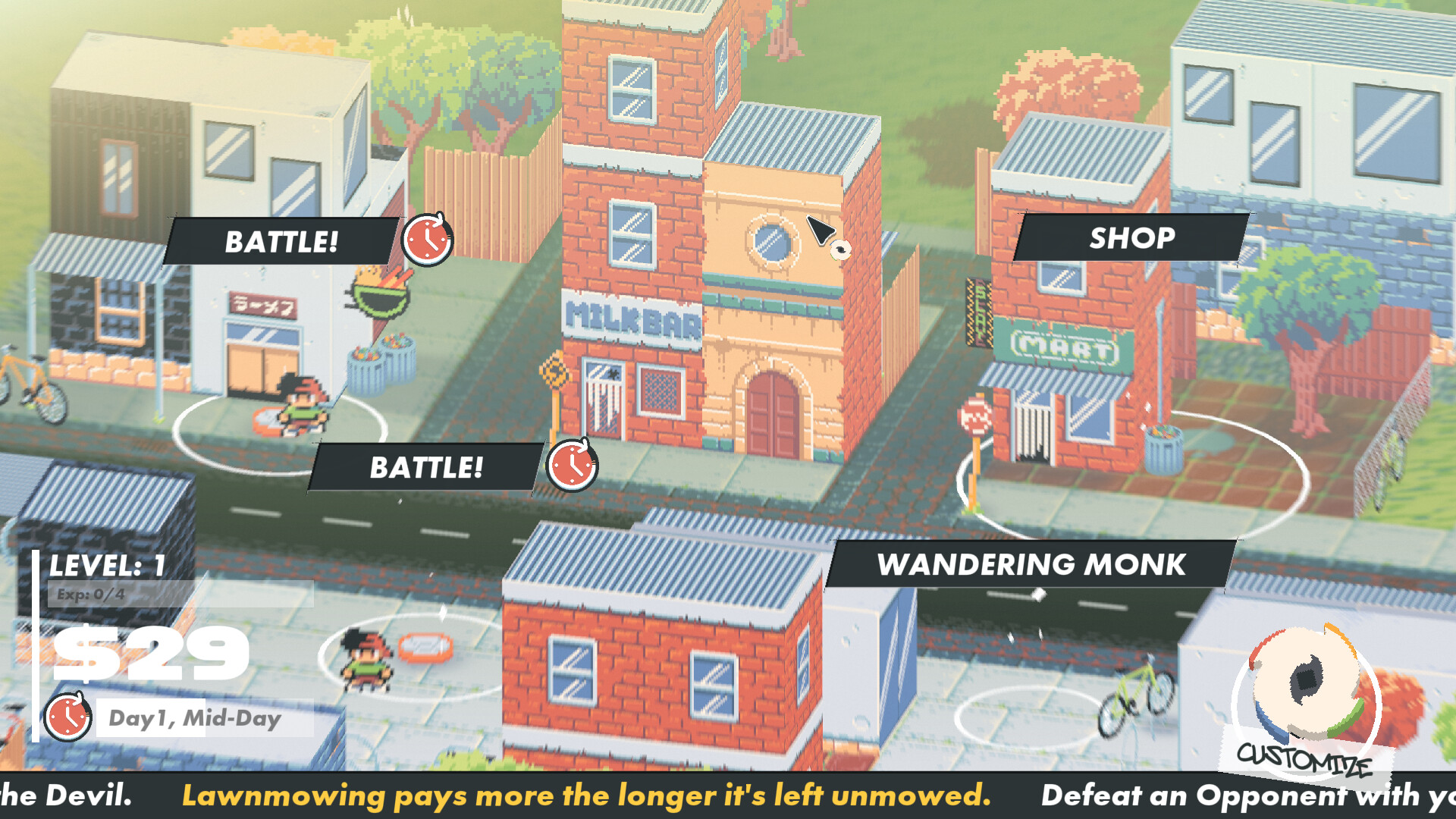
The Y2K city is the run's stage. You skate around a miniature PS1 city, winning Cash and Upgrades on your way to the top. Street corners host the battles; the city's districts hold part shops and challenges.
What Slayblade IS and IS NOT
The developer is unusually blunt about scope. From the Steam page:
What it IS:
- A snappy experience: colorful lo-fi visuals, simple/satisfying battles, fun customization
- Intuitive gameplay: whole game playable with mouse and left-click
- 2000s vibes: street-corner battles, hand-drawn character art, amazing music
- Lots of replay value: 60+ blade parts, loads more unlockables
What it is NOT:
- No big story mode, just a brief intro + outro cutscene
- Not a multiplayer game
That honesty matters for expectations. Slayblade is a single-player, session-based battle game, not a live-service or narrative RPG. The "Save the city from a rich loser" plot is frame, not a 20-hour campaign.
Getting Started: Your First Run
Slayblade releases August 20, 2026, with a demo available on Steam (app 4682290). The demo is the fastest way to learn the loop before launch, it holds a "Very Positive" rating (162 positive, 26 negative) from Next Fest players, and progress carries over to the full game. The developers confirmed the full game has more than doubled the demo's content and addressed every piece of player feedback.
Your first session, in order:
- Build your first blade. Start with the default parts. Do not overthink the first build; the game wants you to feel the battle controls before it asks for optimization.
- Fight your first street battle. Left-click to engage. The controls are the whole game's foundation: simple, satisfying, mouse-only. You spin your top into the bowl, collide with the opponent, and wear down their spin.
- Spend cash on parts. After the first win, buy a new part. The shop is where the roguelite economy begins. Read what each part does.
- Check part powers. Parts do not just add stats; they merge powers. Read each description before stacking.
- Push to the next district. The Y2K city opens up as you win. Each district has stronger opponents and better parts.
- Test in the practice arena. If a part references an aura, a field effect, or a resource-scaling power, try it in a safe fight before you build around it.
Beginner mistakes to avoid:
| Mistake | Why It Hurts | Fix |
|---|---|---|
| Hoarding cash | Cash does not earn interest; unspent money is dead progression | Buy a part after every win that offers one |
| Ignoring part powers | Merging is the stated endgame; raw stat stacking misses combos | Read part descriptions and test merges |
| Expecting a story mode | There is only a brief intro + outro cutscene | Treat each run as the content |
| Waiting for multiplayer | The game is single-player only | The ladder is vs AI, not vs friends |
| Overthinking first build | The default blade teaches controls | Optimize after you feel the battle system |
| Pushing districts too fast | Stronger opponents wipe an un-upgraded blade and waste a run | Grind until your blade consistently wins, then move up |
Controls & Input
Slayblade is designed around a single input: left-click. The Steam page lists a "Mouse Only Option" and the game is "Playable without Timed Input," meaning no quick-time prompts or reaction checks gate progress. Partial controller support exists for players who prefer a gamepad, but the mouse is the intended path.
| Action | Input |
|---|---|
| Navigate menus / select parts | Left-click |
| Engage street battle | Left-click |
| Battle / spin your blade | Left-click (move the mouse to steer your top) |
| Advance dialogue | Left-click |
| Controller (optional) | Partial support, varies by menu |
There is no keyboard requirement. If you find yourself missing cleaner part explanations or tutorial prompts at launch, the developers confirmed they overhauled the tutorial and part-description clarity for the full release after demo players flagged them as weak.
Core Mechanics Deep Dive
Battle System
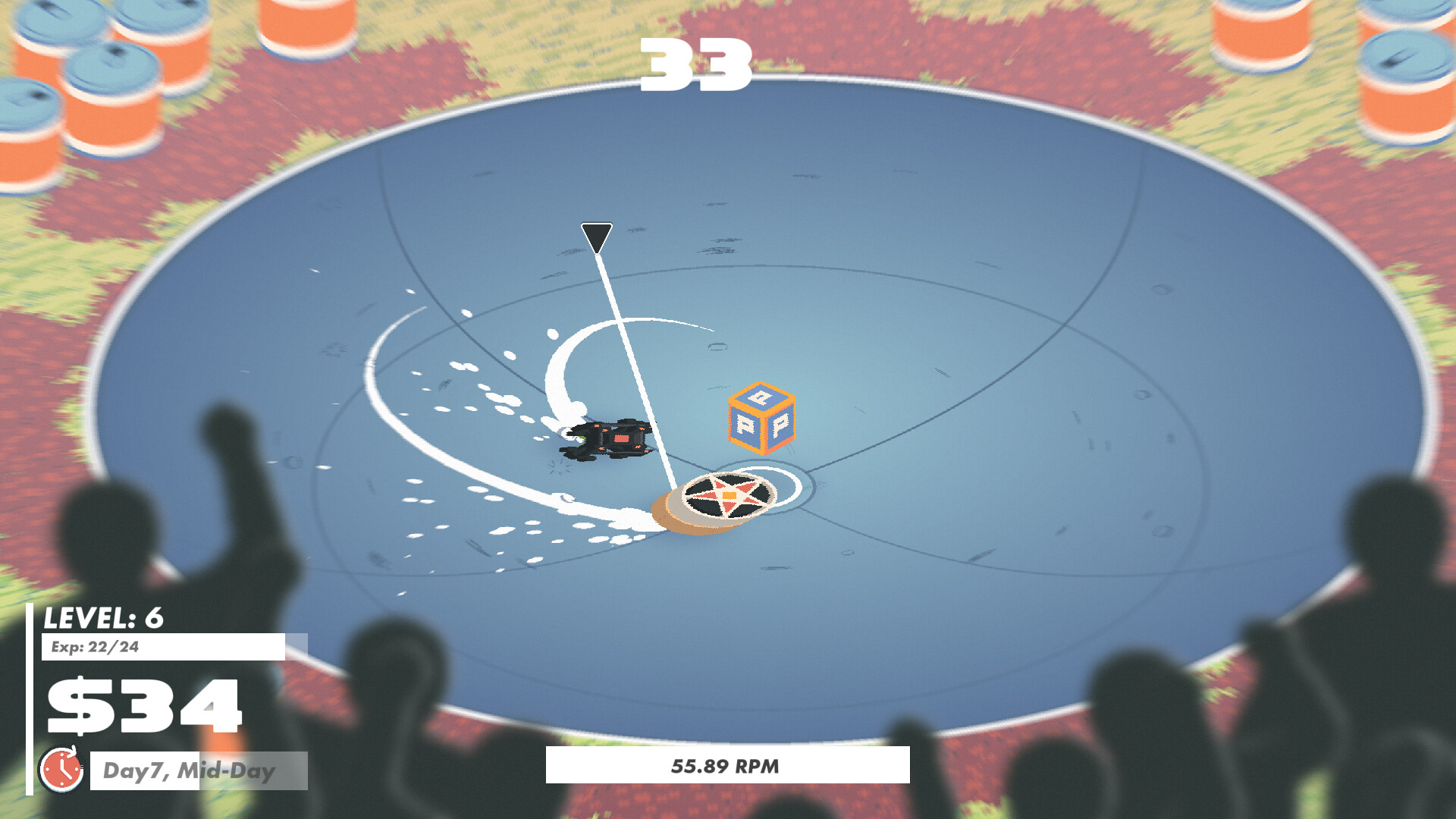
Battles are the heart of Slayblade. Battle-tops collide in street-corner arenas, and your blade's parts determine its behavior: speed, power, durability, and special effects from merged powers. The weight of the blades sells the fantasy; one demo player captured it as "the weight of the blades feel like, well, from an anime." You steer your top with the mouse inside a shallow bowl, trading knockback and spin damage until one blade runs out of RPM.
The battle feel is the product's main selling point. The developer's earlier games (Kardboard Kings, Desert Child) were praised for tactile, satisfying interactions, and Slayblade leans on that same design language: simple input, strong feedback, quick rounds.
Part Collection (60+ Parts)
Over 60 blade parts are collectible. Parts drop from battles, appear in shops, and unlock through progression. Each part affects your blade's performance, and parts combine through the merge system. The demo shipped roughly half the part pool; the full game doubles it.
The 60+ count is the replay driver. Different part combos create different blade archetypes: speed builds, power builds, balanced builds, and the merge system multiplies the combinations beyond simple stat arithmetic.
Merge Powers
The merge system is where Slayblade gets deep. The Steam page's feature list reads "Find INSANE combos with all the parts you Unlock!" Merging parts creates synergy effects that a single part cannot provide.
The roguelite framing means merges are discovered over runs, not just bought. You see a part, try it in battle, and learn which combinations feel broken-good. This discovery loop is the "chill roguelite" hook: low-stakes experimentation with satisfying payoff.
Cash & the Money Economy
Cash is the backbone of progression. You win it in battles and spend it on parts. Two economy lessons matter:
- Cash scales certain powers. The strongest demo build ("Money-Parts") tied power-up strength to your wallet. Saving cash made power-box pickups hit harder, letting one pickup end fights instantly.
- Cash does not reinvest itself. Unspent cash is dead progression. Cycle it into parts unless you are saving for a specific high-value part in the next district's shop.
Power-Up Cubes & Auras
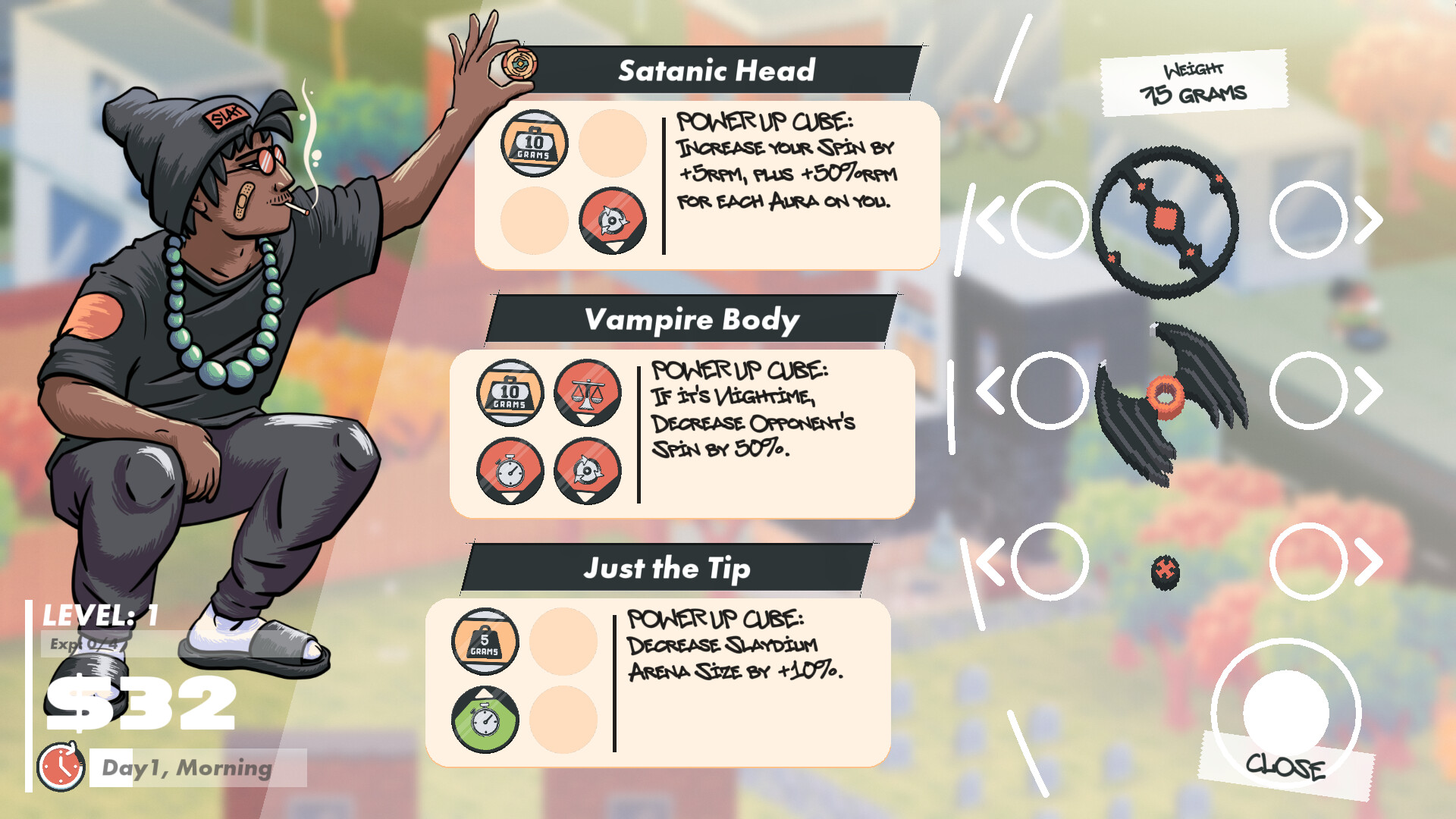
Battles drop power-up cubes or pickups mid-fight. Picking them up modifies your blade mid-battle: boost spin, cut the opponent's spin, or both. How strong the effect is can scale off your cash or build. Several parts and pickups reference auras, field effects that surround your blade and modify spin, knockback, or defense while active. The demo under-explained these; the launch build improves the tutorial. Any aura part you see, buy it and test it early, because misunderstood mechanics are usually either strong or easy to break.
The Y2K City
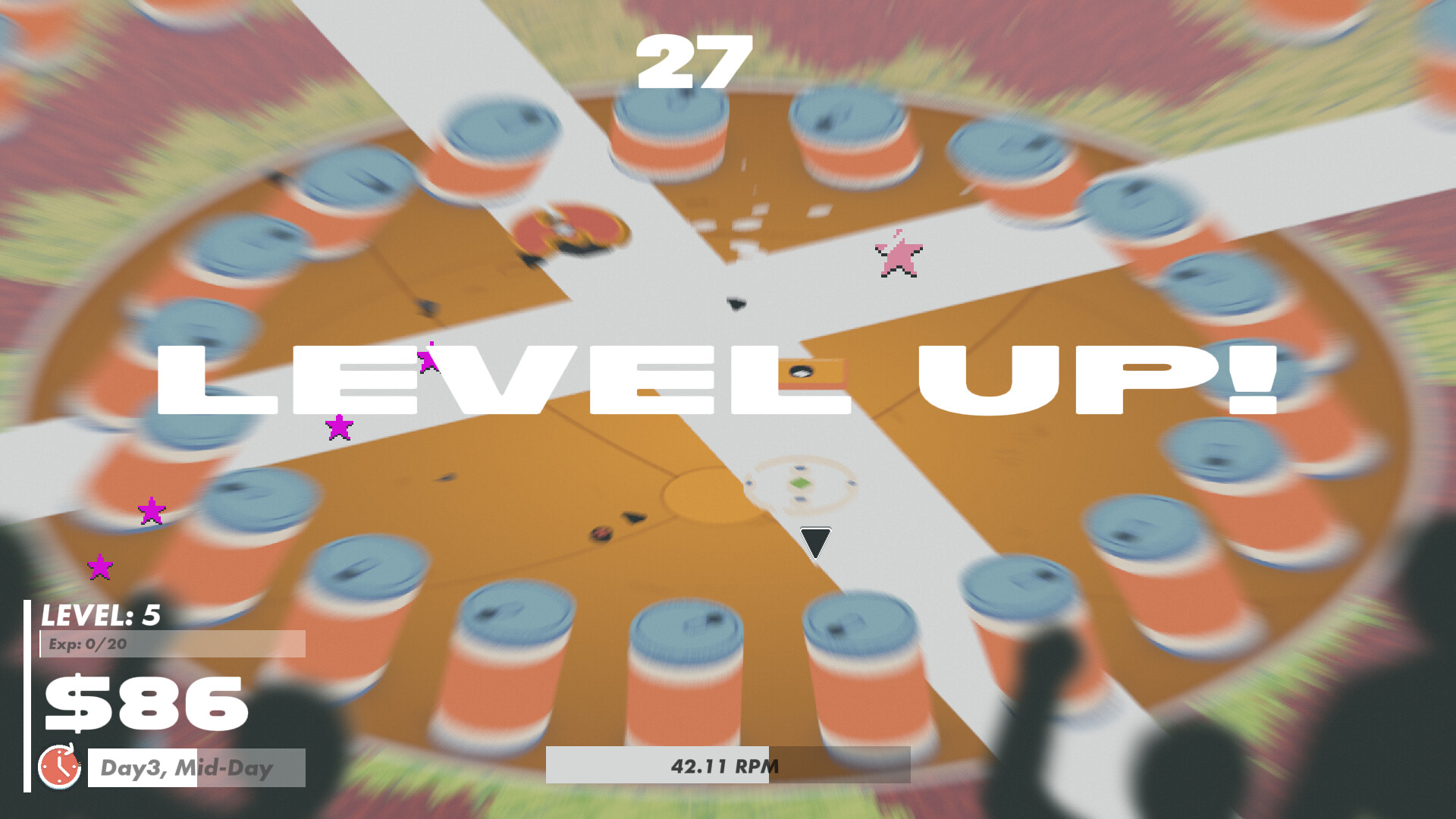
The city is more than scenery. You "skate around a vibrant Y2K city, winning Cash and Upgrades on your way to the top." The city structure gives the run its geography: districts, street corners, shops, and opponents spread across a miniature PS1-inspired environment. Streets connect part shops, challenge points, and battle corners, and the game runs on a day cycle that pushes you to spend and move.
The setting also drives the aesthetic: hand-drawn character art, lo-fi visuals, and "amazing music" evoke 2000s street culture, with a CRT filter that demo players loved. The city is where you "break the law," the game's playful framing for taking on the established street-battle hierarchy.
Progression & Unlockables
Beyond the 60+ parts, the game promises "Loads more Unlockables." The roguelite structure means runs feed a persistent progression layer; parts you unlock stay available for future builds. Demo players found the meta-progression too shallow, which the developers addressed by more than doubling content for launch. Expect a fuller unlock tree at release than the demo offered.
Step-by-Step Strategy: Climbing the Ladder
Here is a repeatable path through a single run, built from how the demo's economy and districts actually behave.
- Open with a balanced blade. Start even; learn the current district's opponents before you commit to an archetype.
- Win your first two street battles. Bank the cash.
- Visit the shop and buy one part that changes how you fight, not a marginal stat bump. Prioritize parts that reference cash scaling, auras, or knockback, since those feed merges.
- Test the new part in a practice/low-stakes fight. Confirm the power does what you expect before you spend more.
- Grind the current district until you win consistently. Do not rush up with an un-upgraded blade.
- Bank for the next tier before moving up. Save exactly enough for one high-value shop item in the next district, then push.
- Merge aggressively once you have two synergistic parts. Read both powers and try them together; a broken combo beats a pile of high numbers.
- Repeat the cycle until the Final Battle. The demo ends before it; the full game's climax is save-the-city versus "a rich loser."
Advanced Strategies
The Merge-First Doctrine
Do not treat parts as stat sticks. The game's endgame is combo discovery, so read every part's power description and actively test merges. A part that looks weak alone can be the linchpin of a broken combo. Buy for synergy, not for the highest number.
Cash Cycling vs. Saving
Spend after every win that offers a part. The roguelite economy rewards cycling: cash in hand is dead weight, parts in hand are progression. The exception is saving for a specific high-value part in the next district's shop; know what you are saving for before you hold. Because cash can also scale power-up strength, a fat wallet is a weapon, not just a bank. Balance a meaningful war-chest against leaving part opportunities on the table.
District Pacing
Do not rush the city's ladder. Each district has stronger opponents, and pushing up with an un-upgraded blade wastes runs. Grind the current district until your blade consistently wins, then move up with cash banked for the next tier of parts. Watch the day cycle: demo players felt pressured to keep pace, so spend decisively and don't idle.
Archetype Building
Build toward an archetype rather than a grab-bag. Speed blades and power blades play differently; committing to one identity makes part choices obvious and merges more powerful. The 60+ part pool supports multiple archetypes, so pick one per run and commit. Do not hybridize until you know the meta.
Builds: The Meta That Emerged From the Demo
Demo players found combos fast, and the full release rebalances exactly those discoveries. The developers said they addressed "every single piece of feedback," which in practice means the demo's dominant strategies got tuned. Still, the archetypes below show how the part system thinks, and the devs confirmed the core loop survives into launch.
The Money-Parts Build (demo king)
The most notorious demo combo. Buy the "$$$" head and tip parts when they appear in the shop, then hoard cash instead of spending it. Power-box pickups scale off your money; players reported that picking up a power-up with a fat wallet increased their spin and cut the opponent's spin to a fraction of their cash value. One player described winning any fight instantly after one power-up, then rolling the winnings into an even bigger wallet.
Why it worked: the merge system ties part powers to resources, and cash is the resource you control most. Every win feeds the wallet, the wallet feeds the power-up, and the power-up ends fights before they start.
Why it will change: the same reviewers who praised it asked for a nerf, and the devs confirmed they rebalanced demo feedback. Expect the launch version to cap power-box scaling or tax hoarding. The lesson survives regardless: read what a part scales off, because resource-linked powers are the game's combo backbone.
The Aura Build (underexplained, potentially strong)
Multiple demo reviews flagged "aura" as a mystery: power-ups and parts reference auras, but the demo never explained them. The devs confirmed tutorial and explanation improvements for launch. What players pieced together: aura parts create a field effect around your blade that modifies spin, knockback, or defense while active.
What to do at launch: the moment you see an aura part, buy it and test it in a low-stakes fight. Underexplained mechanics are usually either undertuned or misunderstood, and the players who figure them out first get a head start on the meta.
The Ring-Out Build (community request)
Several reviews asked for ring-out style hits and stadiums with that gimmick. The demo's arenas are enclosed, but the request is telling: knockback and ring positioning were already part of the battle feel, and players wanted more of it. If launch adds ring-out stadiums, knockback-focused tips and speed blades become the play.
Demo Feedback: What Players Loved and Hated
| Feedback | Detail | Launch status |
|---|---|---|
| Battle feel | "The weight of the blades feel like, well, from an anime lol" | Core selling point, unchanged |
| Money-Parts too strong | Save cash, oneshot everything with a power-up | Rebalanced per dev statement |
| Auras unexplained | No tutorial for aura mechanics | Explanation improvements confirmed |
| Meta-progression shallow | Roguelite structure felt thin in the demo | Content more than doubled for launch |
| Days too fast | Felt rushed to keep up with the day cycle | Pacing feedback addressed |
| Explanations thin | Part stat descriptions not intuitive | Tutorial and stat clarity improved |
| Music repetition | Same three songs looped | Full soundtrack expected at launch |
| Want ultimates / tournaments | Players asked for ultimate abilities and bigger events | Not confirmed for launch |
Part Archetype Tier List (demo-informed)
| Tier | Archetype | Parts to look for | Notes |
|---|---|---|---|
| S | Money | "$$$" head + tip | Demo king; expect rebalance at launch |
| A | Power | High-damage heads, heavy tips | Straightforward, reliable |
| A | Aura | Aura-tagged parts | Mystery power; test at launch first |
| B | Speed | Light bodies, spin-focused tips | Good for positioning and chip damage |
| B | Balanced | Mixed stat parts | Safe for learning the ladder |
| C | Defense | High-durability parts | Slow, but survives mistakes |
The tier list is demo-informed and the launch rebalance shifts it. Use it as a language for thinking about parts, not as a final ranking: the game rewards reading powers and testing merges more than copying a build.
System Requirements & Performance
Slayblade is a light game on "not super heavy for your PC" per demo players, and the official numbers back that up.
| Minimum | Recommended | |
|---|---|---|
| OS | Windows 10 | Windows 11 |
| Memory | 8 GB RAM | 16 GB RAM |
| Graphics | GTX 1080 | RTX 4070 Ti |
| Storage | 500 MB | 500 MB |
The modest footprint (half a gigabyte of storage) and simple 3D arena make it playable on modest hardware. The CRT filter and lo-fi visuals add charm without loading the GPU. Windows is the only supported platform; there is no macOS or Linux build. The game supports custom volume controls and Steam Cloud, so your parts and unlocks sync across machines.
Steam Deck / Linux Note
There is no official native Linux or macOS build, and no verified Steam Deck profile listed at launch. The entire game runs on a mouse and left-click, which is awkward on a touch-centric Deck in handheld mode; if you want to play on Deck, being docked with a mouse, or using the partial controller support, is the realistic path. Partial controller support means gamepad layouts exist, but the mouse-only design means some menus may still assume a pointer.
Developer Background
Henry's House is the studio of Oscar Brittain, an indie developer known for:
- Nanomon Virtual Pet, a pet-raising game with a lo-fi aesthetic
- Kardboard Kings, a card shop management game about running a trading-card store
- Desert Child, a hoverbike racing RPG set in a near-future desert
The through-line: tactile loops, lo-fi visuals, and games that respect short sessions. Slayblade continues that pattern with the battle-tops concept, and the dev team (Oscar and Rob) runs an active Discord where they've answered player feedback since Next Fest. The studio's website is henryshouse.com.au.
Comparison With Similar Games
| Game | How it compares |
|---|---|
| Beyblade (toy line / anime) | The conceptual ancestor. Slayblade keeps the spinning-top battles but adds the roguelite run structure, part merging, and the Y2K city you skate between fights. |
| Beyblade video games (GBA era) | The nostalgia target. Reviews explicitly compared Slayblade to the Game Boy Advance Beyblade games, with the modern addition of roguelite runs. |
| Kardboard Kings | Same developer's shop-management loop. Slayblade trades cards for tops but keeps the buy-sell-upgrade rhythm and tactile feel. |
| Desert Child | Same developer's hoverbike racing RPG. Same lo-fi presentation, same short-session design, different combat loop. |
| Roguelite deck-builders (Slay the Spire lineage) | Same "discover combos over runs" loop, but real-time instead of card-based. If you like finding broken synergies, Slayblade scratches that itch with spin physics. |
Update History & Roadmap
| Date | What happened |
|---|---|
| Jun 2026 | Steam Next Fest demo released (app 4682290). "Very Positive" rating (162/26). |
| Jul 2026 | Developers confirm all Next Fest feedback is being addressed; direct players to Discord. |
| Aug 2026 | Release date announced. Developers confirm content more than doubled from demo, all feedback addressed. |
| Aug 20, 2026 | Full release on Steam (Windows). |
The launch build is a substantial expansion of the Next Fest demo. The developers explicitly said they doubled the content and worked through "every single piece of feedback," which covers the Money-Parts balance, aura explanations, day pacing, and meta-progression depth flagged by players. Expect the tutorial and part descriptions to be clearer at launch, plus more parts, unlockables, and the full Final Battle the demo cuts before.
FAQ
When does Slayblade release? August 20, 2026, on Steam. A demo (app 4682290) is available now and rates "Very Positive."
How much does Slayblade cost? Price is TBA as of pre-launch. The demo is free.
Is Slayblade multiplayer? No. It is explicitly single-player, with no multiplayer features.
Does Slayblade have a story mode? No big story mode, just a brief intro and outro cutscene. The plot frame is "save the city from a rich loser."
What are the controls? The whole game can be played with a mouse and left-click. Partial controller support is available.
How many parts are there? Over 60 collectible blade parts, plus more unlockables and a post-launch DLC.
Is there a demo? Yes, Slayblade Demo (app 4682290) is free on Steam, and progress carries over to the full game.
What platforms is Slayblade on? Windows via Steam only. No macOS or Linux build.
Is Slayblade like Beyblade? Conceptually yes, battle-tops in street arenas, but the roguelite run structure, part merging, and Y2K city setting make it its own game.
Will the demo's broken Money-Parts build still work at launch? Unlikely, the developers said they rebalanced every piece of feedback, and the Money-Parts combo was the most requested nerf. Learn the principle (read what parts scale off) rather than the build.
Final Tips
Buy for merges, not stats. Slayblade's 60+ parts are a combo-discovery engine, and the players who read part powers and test combinations will find the "insane combos" the game promises. Cash cycles fast, districts escalate, and each run teaches you one more merge. That is the whole game, and it is a good one.
Verdict: 4/5 for the target audience. A satisfying, snackable battle-tops roguelite with real combo depth and a charming Y2K setting. Buy it if you want short, tactile battle sessions with deep customization; skip it if you need multiplayer or a story campaign.
Last reviewed by Game How To Editorial. We play each game, verify controls against official sources, and update guides when game mechanics change.