Official game
Play Monk Took Book
This game is hosted by Steam. Continue to the official page to play or download it.
Wishlist on SteamMonk Took Book — Deep Dive Strategy Guide
Overview
Monk Took Book is a cozy-creepy library simulator from SquarePlay Games, the two-person team of Alastair and Sarah behind Space Trash Scavenger. It releases on Steam on September 3, 2026. You play a novice monk on Holy Island, home to the greatest monastic library of the Dark Ages, tasked with running the place and completing the Legendary Collection.
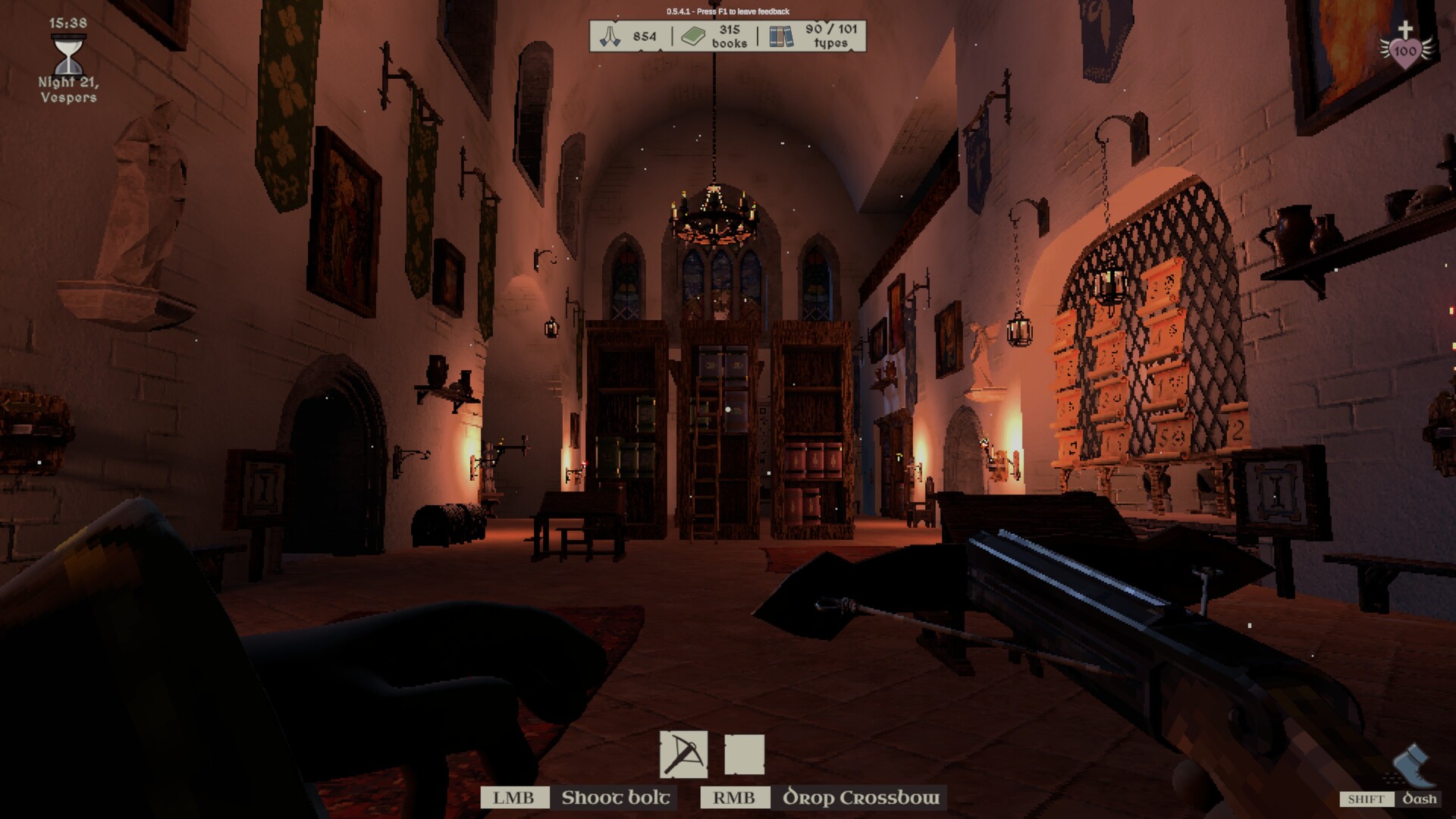
The core loop is a memory game wrapped in a management sim. Every morning new books arrive, each bearing a distinct symbol on its cover. You remember the symbols, place the books on shelves according to your own design, and when night comes you deliver the Scribes their chosen tomes. Forget where you shelved something and the night shift turns into a hunt through your own library.
The twist is that the abbey is not safe after dark. Vermin, spirits, and Viking ghosts assail the Collection, so you take up a dagger, crossbow, or holy cross to preserve your labors, then use a quill to restore any damaged books. The whole thing runs on systems-based emergent gameplay: simulated flame and combustion, water dousing by pail, the chaotic physics of tumbling and thrown books, a day and night cycle, ballistic weapons, and melee combat.
Who it is for: Fans of cozy sims with real systems underneath (Unpacking's organization itch, Overcooked's co-op chaos, Book of Hours' library fantasy), and anyone who wants a chill game with optional combat you can dial down or disable.
Who it is not for: Players who want a fast-paced action game or a deep story. This is a slow, deliberate management sim where the "threat" is entirely optional and the real challenge is your own memory.
| Fact | Detail |
|---|---|
| Developer | SquarePlay Games |
| Publisher | SquarePlay Games |
| Genre | Cozy-creepy library simulator |
| Platforms | Windows |
| Release | September 3, 2026 |
| Price | To be announced |
| Players | Solo or online co-op, up to 4 players |
| Camera | First or third person |
| Combat | Dagger, crossbow, holy cross (optional) |
| Accessibility | Arachnophobia mode, granular difficulty, disable enemies |
| Multiplayer | Proximity voice chat, lobbies, Steam invites, join codes |
| Requirements | Win 10, i5, GTX 1050 4GB (min); Win 11, i9, RTX 2070 8GB (rec) |
Getting Started — The First Night
Before You Launch
- Understand the day/night rhythm. Mornings are for receiving books, shelving them, and earning Blessings. Nights are for delivering tomes to Scribes and defending the Collection. Plan your shelf system on day one; it sets the tone for every night after.
- Set your difficulty honestly. The game offers granular options: reduce, increase, or disable some or all enemies, and control book rates for a more chill experience. If you want pure cozy, disable enemies and set low book rates. There is no shame in it — the game explicitly supports it.
- Decide solo or co-op. Up to four monks can share the abbey. Co-op adds proximity voice chat and shared labor; solo pauses the game in menus and dialogs.
- Learn the Perks system early. The Abbot rewards your toils with Blessings. Spend them on Perks to level Strength, Speed, and Carpentry, or expand the Collection with new shelves and chambers.
- Test the controls. Playable first or third person with full key rebinding. Controller and keyboard/mouse hotswap is handled cleanly — the HUD updates input prompts live.
Your First Morning
- Receive the morning delivery. Every book bears a symbol on its cover. This symbol is your memory hook — say it aloud or assign a mental spot per symbol.
- Shelve with a system, not vibes. The game lets you design your own layout, but the fastest way to lose a night is scattering books randomly. Commit to a zone per symbol family (spirits left, beasts right, or whatever works for you).
- Don't over-stack. Books can be carried in great stacks or thrown vast distances. Tall stacks are efficient but one tumble scatters the whole pile — and physics is chaotic.
- Spend Blessings on Carpentry first. Raising new shelves and unlocking chambers gives you more space, which directly reduces the memory load per night.
- Find the book thief's footprints. A creepy little guy can lurk at night stealing from your collection. If books vanish, follow the footprints to track him down.
Beginner Mistakes
| Mistake | Why It Hurts | Fix |
|---|---|---|
| Shelving randomly | Night deliveries become a blind hunt through the whole abbey | Use a consistent symbol-to-zone system from day one |
| Over-stacking shelves | Tall stacks tumble, scattering books and losing your layout | Balance stack height against reachability |
| Ignoring Blessings | Perks and new shelves compound; skipping them stalls your whole library | Spend Blessings on Carpentry and Speed early |
| Treating enemies as the main threat | The real loss is time spent fighting instead of shelving | Disable or reduce enemies if they cut into your routine |
| Not using the quill | Damaged books stay damaged and the Collection degrades | Repair books as soon as the night wave ends |
| Hoarding books in stacks | Books left in piles get stolen or knocked over | Put every book on a shelf by nightfall |
Core Mechanics Explained
The Day and Night Cycle
Each day begins with a delivery of new books, each marked with a distinct symbol. Shelve them, earn the Abbot's favor, and when night falls the Scribes request specific tomes. Your job is to remember where you put each symbol and deliver the right book. This is the memory core of the game: the symbol on the cover is the only link between a request and a shelf location.
The night also brings the optional threat layer. Vermin gnaw at your collection, spirits and Viking ghosts haunt the isle, and a book thief can steal from you. Combat is ballistic and melee: daggers for close work, crossbows for range, the holy cross for spirits. Parrying exists — the Next Fest demo added more depth to it alongside the Viking ghost redesign.
Blessings and Perks
The Abbot rewards your daily toils with Blessings, the game's currency. Spend them on:
- Perks that level up Strength, Speed, and Carpentry. Strength affects carrying and combat, Speed affects your movement and delivery pace, and Carpentry affects building and shelving.
- The Collection itself: raising new, lofty shelves and unlocking new chambers expands the library and gives you more places to organize.
Combat and Defense
All enemies are optional. The default game has them; granular difficulty lets you reduce, increase, or disable some or all. The roster:
- Vermin and rats — the baseline nuisance. They attack, bite, and can climb shelves.
- Spiders — shelf-climbing web-builders. The arachnophobia mode changes them for players who need it.
- Viking ghosts — the abbey has been raided for years and the dead raid it still. Several flavours of skeletons, some stronger and better at blocking than others.
- The book thief — a creepy little guy who steals from the collection at night. Follow his footprints to track him down.
Your tools: the dagger, the crossbow, and the holy cross. After a wave, use the quill to restore any damaged books.
The Physics and Systems Sandbox
The abbey is a systems playground. Books tumble with chaotic physics. Fire is simulated — flame spreads and consumes — and you douse it with pails of water. You can carry books in great stacks or throw them vast distances. It all feeds the emergent gameplay the developer emphasizes: a thrown book can knock something over, a candle can start a fire, a misplaced stack can collapse.
Co-op and Lobbies
Up to four players share the library. The game includes proximity voice chat, public and private lobbies, Steam invites, copy/paste lobby join codes, and in-game text chat. Input hotswapping between controller and keyboard/mouse is handled with HUD updates.
Quality of Life
Full key rebinding, manual and autosave, FoV slider, headbob slider, gamma slider, window or fullscreen mode, and widescreen support. The demo patch also added a HUD alert when a different controller input scheme is detected.
Advanced Strategies
The Symbol-Zone Memory System
Assign each symbol family a permanent zone on day one. Spirits left, beasts right, history center — whatever mapping sticks. The night requests become a deterministic route instead of a scavenger hunt, and your delivery time drops to a fraction. The memory test is the game's real difficulty, so beat it with structure, not luck.
The Carpentry-First Progression
Spend the first Blessings on Carpentry and Speed. More shelves mean more books organized per day and less night-time chaos. Speed makes deliveries and repairs faster. Strength matters once combat ramps up, but it's the third pick for a reason: a well-shelved library fights half its own battles.
The Two-Shift Co-op Split
In co-op, split the abbey into two shifts: one monk shelves new arrivals while the other patrols and repairs. The shelving monk keeps the memory system intact; the patrol monk handles vermin and the thief. Swap each day so both players keep their mental map of the collection fresh.
The Fire Drill
Fire is the one disaster that can undo a whole shelf system. Keep a pail of water near the highest-traffic shelves, and if a fire starts, douse the source before the spread reaches your organized sections. A scattered, burned library costs an entire night cycle to rebuild.
Difficulty Tuning as a Strategy
The granular difficulty is a tool, not a crutch. Want a cozy game? Disable enemies entirely. Want a challenge? Max enemies and book rates. The developer explicitly built the sliders for this, and the "chill experience" control on book rates means you can play at whatever stress level you want without losing the core sim.
FAQ
When does Monk Took Book release? Thursday, September 3, 2026, on Steam.
How much does it cost? Price is to be announced. The game is wishlistable now.
Is there a demo? Yes, a co-op demo was updated for Steam Next Fest 2026 with new book sizes, the book thief, Viking ghosts, and deeper combat. A demo patch (0.5.7.4) fixed rats, spider climbing, and tutorial deaths.
Is it single-player or multiplayer? Both. Solo play pauses in menus and dialogs; online co-op supports up to four players with proximity voice chat.
Does it have controller support? Partial controller support, with clean hotswapping between controller and keyboard/mouse and full key rebinding.
Are the enemies optional? Yes. Granular difficulty options let you reduce, increase, or disable some or all enemies, and you can control book rates for a more chill experience.
Is there an arachnophobia mode? Yes, the game includes one.
What are the system requirements? Minimum: Windows 10 or later, Intel Core i5 or equivalent, desktop Nvidia GTX 1050 4GB or equivalent. Recommended: Windows 11, desktop Intel Core i9, desktop Nvidia 2070 8GB. Integrated GPUs and low-spec mobile laptop GPUs are not supported.
What languages are supported? English with full audio support.
Does progress save? Manual and autosave are both included.
Can I play first or third person? Both cameras are supported.
Is there text chat? Yes, in-game text chat alongside proximity voice chat.
Final Tips
Build your symbol-zone system on the first morning and never abandon it. The monks who thrive aren't the ones with perfect combat — they're the ones who shelve with structure, spend Blessings on Carpentry early, and keep a pail of water near the good shelves. Monk Took Book takes the cozy-sim premise and makes the real enemy your own memory, which is exactly why it works. Watch for the September 3 launch, try the Next Fest demo if you're on the fence, and bring three friends if you want the abbey running at full chaos.
Last reviewed by Game How To Editorial. We play each game, verify controls against official sources, and update guides when game mechanics change.
Screenshots